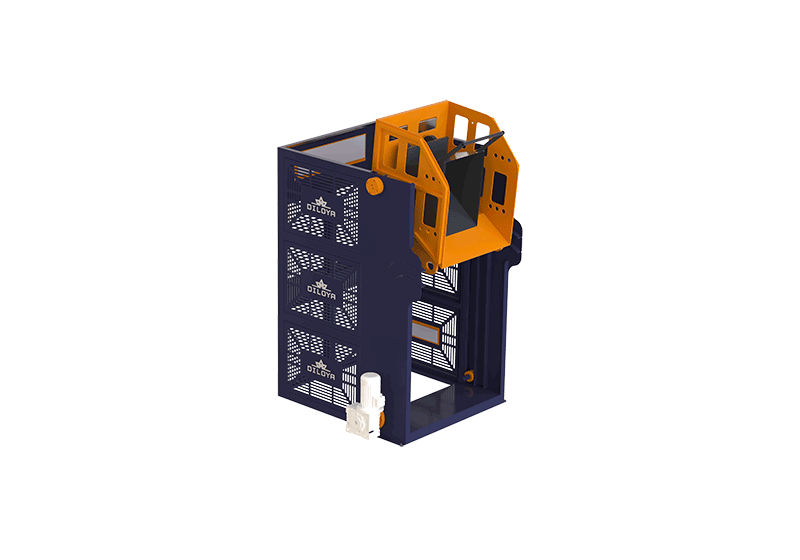
Automated trolley lifting and tipping for metal chips
The DILOYA Lift-Flipping Device is a material-loading accessory for metal-turnings preparation and briquetting systems. It raises a compatible trolley to a specified feeding height and tips its contents into the receiving equipment. Typical duties include feeding long or tangled metal turnings to a shredder and feeding suitable short metal chips to a briquetting-machine hopper.
The device addresses the handling stage between chip collection and processing. Rather than repeatedly shovelling chips or manually lifting containers, the operator positions an approved trolley at the loading station and initiates the configured lifting and tipping sequence.
Parameter:
| Model | ATF300 | ATF500 |
| Power | 2.2kw | 3kw |
| Max. Lift Weight | 300kg | 500kg |
| Lift Height | 1800mm | 2500mm |
| Machine Weight | 1560kg | 1950kg |
Loading a shredder or briquetting-machine hopper
For shredding lines, a trolley containing suitable metal turnings is raised to the shredder's receiving height and tipped into its hopper. The shredder then performs the required size reduction; the lift-flipping device handles loading, not shredding.
For briquetting systems, a trolley of suitable short chips is lifted and discharged into a compatible receiving or buffer hopper. The press-feeding system subsequently supplies the material to the compression chamber. Long, tangled swarf must not be assumed suitable for direct press feeding merely because it can be tipped into a hopper.
Typical working sequence
1> Collect suitable material: use an approved trolley and keep the load within its agreed capacity and fill condition.
2> Position the trolley: move it into the designated loading station.
3> Secure and check: engage the trolley retention arrangement and complete the checks required by the operating procedure.
4> Lift: the device raises the trolley to the specified discharge position.
5> Tip and unload: the trolley is rotated to transfer material into the receiving hopper.
6> Return: the device restores the trolley to the unloading station so it can be released and removed safely.
The sequence, operating controls and level of automation are confirmed for the selected model and production line. Automatic lifting and tipping does not necessarily include autonomous trolley delivery or removal.
Reducing manual handling and labour intensity
Mechanical lifting and tipping reduces repeated manual handling of loaded containers and the need to move chips into an elevated inlet by hand. It can help organise the loading operation, reduce operator physical effort and support more efficient use of labour around the processing equipment.
The actual improvement depends on trolley availability, collection distances, loading frequency, receiving-hopper capacity and the downstream production rate. No fixed labour-saving percentage or total line-output increase is specified without an assessment of the complete workflow.
Matching the trolley and lifting duty
Trolley compatibility must be established before selection. Important inputs include external dimensions, wheel and base geometry, retention points, tare weight, maximum loaded weight and the material's centre of gravity during lifting and tipping.
The rated lifting duty must account for the complete loaded trolley, not only the chip weight. Loose bulk density varies considerably between metal types and chip forms, so two apparently similar trolley volumes can impose different loads.
Tipping behaviour also depends on the material. Free-flowing short chips and tangled turnings do not empty in the same way. Hopper geometry, tipping position and loading schedule should be evaluated to avoid overfilling the receiver or obstructing the downstream feed.
Integration into a connected production line
The Lift-Flipping Device can be arranged beside a matched shredder or briquetting system to create a connected loading station. Engineering coordination covers the trolley approach, lifting envelope, discharge height, tipping direction, receiving-hopper size and available installation space.
Controls and receiving-equipment interfaces can be specified to coordinate the loading cycle with production demand. Required interlocks, operating permissions and protective arrangements are confirmed for the installation rather than assumed from the machine image.
A suitable buffer hopper can reduce the need to tip a trolley every time the press requires material. However, hopper volume, replenishment frequency and equipment capacity must still be matched to the actual production schedule.
Suitable material-handling applications
> Steel and iron turnings: trolley loading to a shredder where size reduction is required.
> Aluminium and copper turnings: compatible collection and loading arrangements selected around their bulk behaviour.
> Short metal chips: trolley discharge to a matched briquetting-machine receiving or buffer hopper.
> Other approved chip streams: assessed for load weight, fluid condition and discharge behaviour.
Operating and safety considerations
Use only approved trolleys and loading conditions. Keep people clear of the lifting and tipping envelope, and follow the selected machine's operating and isolation instructions. Never enter a raised-load area or attempt to release obstructed material while the device is operating.
Inspect the trolley retention system and lifting components according to the maintenance schedule. Oil or coolant carried with the chips should be considered in the collection and housekeeping arrangements. The lifting device is not a fluid-separation machine.
Information needed for selection
Provide trolley drawings or dimensions, empty and fully loaded weights, metal and chip type, fill level, required loading frequency and the receiving machine model. Include the required tipping height, hopper dimensions, preferred approach direction, available space and local power supply.
DILOYA will assess the trolley, lifting duty and receiving equipment together. The objective is a reliable loading sequence that reduces manual handling while maintaining a practical match with the shredder or briquetting line.