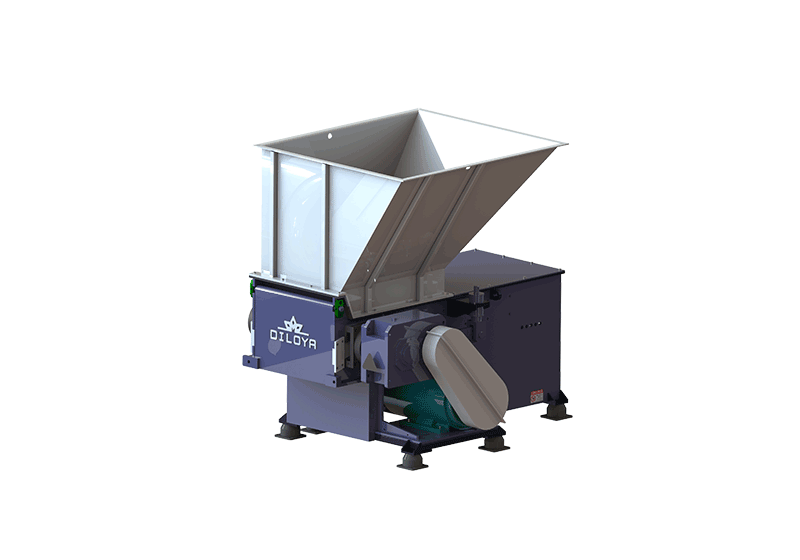
Screen-controlled shredding before briquetting
The DILOYA Single Shaft Shredder is a material-preparation accessory for metal-turnings briquetting systems. It processes suitable curled, long or tangled machining chips into smaller pieces that can be transferred and fed more consistently to a matched briquetting machine. Typical applications include steel and iron turnings, copper turnings and aluminium turnings from machining workshops and central chip-handling operations.
This machine combines a single-shaft cutting design with a sizing screen. Unlike a preparation stage selected only to break up chip bundles, the screen provides an additional means of controlling the discharge. The required screen opening is selected around the material characteristics, desired chip size and downstream feeding system.
Parameter:
| Model | PSN400 | PSN600 | PSN800 | PSN1000 | PSN1200 |
| Chamber Size | 400x400mm | 600x600mm | 800x800mm | 1000x1000mm | 1200x1200mm |
| Rotor Diameter | 270mm | 270mm | 400mm | 420mm | 420mm |
| Motor Power | 15+1.5kw | 22+1.5kw | 45+2.2kw | 55+3kw | 75+3kw |
| Machine Weight | 1850kg | 2370kg | 3670kg | 5680kg | 7250kg |
How the single-shaft design works
A single cutting rotor engages the turnings in the cutting chamber and reduces the material through repeated cutting. Long curls and tangled bundles are broken down into more manageable pieces. The screen controls the route out of the cutting chamber: material that cannot pass through the openings remains for further processing, while suitably reduced chips discharge to the next stage.
The rotor and cutter configuration must be selected for the actual machining swarf. Ferrous chips, copper turnings and lightweight aluminium swarf do not behave identically under cutting. Chip hardness, thickness, shape and loading consistency all influence the shredding process and achievable output.
Choosing the screen opening
Screen aperture is an important control over discharge size. A smaller opening generally retains material for more processing and produces a finer discharge. A larger opening allows coarser material to leave the chamber and may support a higher processing rate when the material and cutting arrangement are suitable.
The opening should not simply be made as small as possible. Excessively fine preparation may add cutting work, increase recirculation inside the chamber and limit throughput without providing a useful benefit to the press. The objective is a chip size that the conveying, buffering and briquetting equipment can handle reliably.
Screen opening is not a guarantee that every discharged chip has the same length or shape. Slender or elongated chips may pass through an aperture in different orientations. The actual size distribution depends on screen geometry, cutter arrangement, chip shape and operating conditions. Representative material trials can help establish a suitable configuration.
Materials the shredder can prepare
> Steel and iron turnings: suitable long or curled ferrous machining swarf requiring controlled size reduction before pressing. Hardness and chip thickness must be evaluated.
> Copper turnings: curled or intertwined copper chips that need preparation for a more manageable material flow into the briquetting system.
> Aluminium turnings: lightweight and bulky aluminium machining chips whose tangled form can make direct press feeding difficult.
> Other metal swarf: suitability is assessed from the alloy, chip geometry, contamination and required downstream process.
Keep different metals and alloy grades separated where required by the recycler or remelting process. Remove tools, bars, heavy solid offcuts and other unsuitable contaminants before loading. A machine configured for machining turnings should not be treated as an unrestricted mixed-metal scrap shredder.
Typical processing sequence
1> Collect and sort: identify the metal, separate grades where necessary and remove unsuitable contaminants.
2> Controlled loading: introduce suitable turnings into the hopper at a rate matched to the selected shredder.
3> Single-shaft shredding: the cutting rotor breaks up chip bundles and reduces the turnings.
4> Screen-controlled discharge: material passes through the selected openings when sufficiently reduced for discharge.
5> Transfer and buffering: prepared chips are collected or delivered through suitable conveying equipment to a buffer hopper.
6> Briquetting: the matched feeding system supplies the prepared chips to the hydraulic press for compaction.
Integration with a briquetting line
The Single Shaft Shredder can be selected as part of a new line or assessed for integration with an existing briquetting machine. The shredder discharge, screen opening, transfer arrangement, buffer capacity and press inlet must be considered together. A suitable chip size for one press or screw feeder may not be the best choice for another.
A buffer hopper can help accommodate the different operating cycles of the shredder and press. However, the average capacities of the connected machines must still be matched. Buffer storage cannot maintain production indefinitely if the shredder supplies less material than the press consumes.
Shredding is a size-reduction process, not a substitute for dedicated coolant or oil separation. If the project requires a specific residual-fluid condition, an appropriate separation stage must be evaluated alongside shredding and briquetting.
Practical benefits
> Controlled preparation: screen selection provides a way to match the discharge to downstream handling requirements.
> Reduced tangling: breaking up long chips helps address handling difficulties caused by loose swarf nests.
> More consistent feeding: suitably prepared material can be easier for a matched conveyor or press feeder to handle.
> Process flexibility: the selected screen and cutting configuration can be evaluated for different metals and chip conditions.
> Coordinated operation: the shredder can form part of a connected material-preparation and briquetting arrangement.
Screen care and operating considerations
Inspect cutters and the screen according to the maintenance schedule. Wear, damaged openings or material build-up can change discharge behaviour and affect performance. Screen cleaning, inspection and replacement must be carried out only after the machine has been stopped and isolated in accordance with its operating instructions.
A change of screen should be assessed together with its effect on throughput, material flow and downstream feeding. Do not assume identical production rates when changing metals, chip geometry or aperture size.
Information needed for selection
Provide photos or representative samples of the turnings, metal and alloy details, typical chip length and thickness, loose bulk density, oil or coolant condition and required hourly throughput. Include the proposed discharge-size requirement, briquetting-machine model, feeding method, available installation space and local power supply.
DILOYA will evaluate the cutting arrangement and screen together with the rest of the line. The aim is to prepare the chips to a useful size for reliable transfer and briquetting, without unnecessary size reduction or an avoidable bottleneck. Final capacity, aperture and discharge specification are confirmed for the selected material and machine configuration.