Stevia

Dried stevia leaves are a low-density botanical material that needs careful handling. DILOYA compresses prepared leaves into controlled blocks and bags them for organised storage and transport while accounting for leaf breakage, moisture and buyer quality requirements.

What our engineers evaluate

Our engineers evaluate dried stevia leaf size, moisture, fines and allowable breakage, loose density, target bagged-block weight and dimensions, film or liner requirements, lot traceability, sanitation, hourly throughput and local power supply.

Discuss your application +
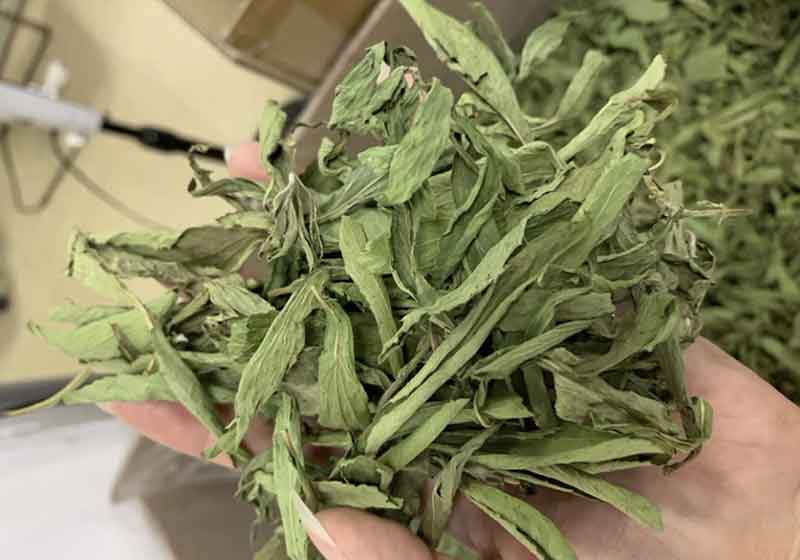
Loose dried stevia leaves and stems

Stevia is a harvested botanical crop whose dried leaves may be supplied to qualified processors for extraction or other permitted downstream uses. Loose leaves have low bulk density and can scatter, absorb moisture or become contaminated during repeated handling. DILOYA configures a controlled compression and bagging process for prepared stevia leaves, turning loose feedstock into identifiable packages that are easier to count, stack and transport.

Typical uses of bagged stevia leaves

Bagged dried stevia leaves are primarily a transport and storage format for processors working with steviol-glycoside raw material. The final use of the leaves depends on the buyer's extraction process, specifications and applicable food or agricultural rules. Packaging should protect lot identity and allow the processor to inspect origin, condition and cleanliness. This application describes physical packaging only; it does not claim to improve sweetness, extract yield or regulatory status.

Controlled compression and packaging

Leaves are sorted and dried to the agreed condition before entering a gentle metering system. Hydraulic compression forms a manageable block; the pressure and cycle are chosen to limit unnecessary fragmentation and excessive fines. The block is placed in an appropriate protective bag, closed, weighed and labelled for traceability. Where needed, contact surfaces, dust control and cleaning procedures are designed around the customer's quality programme.

Material quality and equipment selection

Leaf size, dryness, fines content, loose density and allowable breakage vary between harvests and processors. Over-compression can damage the leaf structure, while insufficient compression leaves excessive void space. DILOYA therefore reviews representative samples, the desired package mass and dimensions, bag specification, throughput, site layout and sanitation requirements before recommending a configuration. Storage conditions and any food-contact requirements must be confirmed by the customer and relevant authorities.
FAQ

How do I choose the right recycling process for my material?+

The right process is the one that produces a material your next customer or production stage can use. Bulky offcuts intended for transport need a different route from oily machining chips intended for remelting. Define that destination first, then work backwards through sorting, size reduction and compaction. How to Choose a Metal Chip Briquetting Line for a Small CNC Machine Shop illustrates why the upstream chip condition matters as much as the final press.

Baling, shearing, shredding and briquetting solve different handling problems. Send representative photos or samples and the buyer's acceptance requirements so the proposed process can be matched to both the incoming waste and its next use.

What information should I send for an accurate quotation?+

An accurate quotation needs an operating brief, not just a requested tonnage. Show the supplier the most difficult normal feed, describe the accepted finished product and identify the equipment already available at the site. Two quotations labelled “one tonne per hour” can cover very different processing stages; the information below helps make their scope comparable.

Useful information to include

  • Feed: material, size, contamination and sample photos.
  • Workload: daily mass, peak accumulation and available production hours.
  • Result: required package or cut size and the receiver's acceptance criteria.
  • Interfaces: loading method, collection equipment and any existing machines.
  • Site: layout, supply voltage, ambient conditions and destination.

Explain how material will arrive and how finished products will be removed. A floor plan, loading height and downstream equipment details help define the scope. The quotation should clearly distinguish the main machine, options, installation requirements and services.

How should I calculate the capacity my operation needs?+

Calculate demand from accepted processed mass divided by genuinely available production time. Then check peak accumulation separately: a line may meet the daily average yet fall behind during the busiest shift. Do not add an arbitrary safety margin before finding whether feeding, preparation or discharge is the real constraint. For chip-processing projects, How to Choose a Metal Chip Briquetting Line for a Small CNC Machine Shop explains the whole-line approach.

Example: processing 8 tonnes in 8 genuinely available production hours requires an average of 1 tonne/hour. If only 6 hours remain after the necessary tasks and interruptions, the required average during those hours is higher. These values illustrate planning, not a machine rating.

Use realistic measured availability and identify whether the proposed capacity includes all required handling stages.

Also consider the complete line. A fast press cannot compensate for an undersized shredder, slow bag placement or restricted discharge. State both average demand and peak accumulation so working buffers and sustained capacity can be selected sensibly.

Leave A Message

Let's Figure Out The Best Solutions!

Tell us what you need.

Share your material, target hour capacity and other requirements. Our engineering team will reply with a suitable solutions.

01Call DILOYA+86 152 2134 765002Email our teaminfo@diloya.com
We use your details to respond to this enquiry. Read our Privacy Policy.