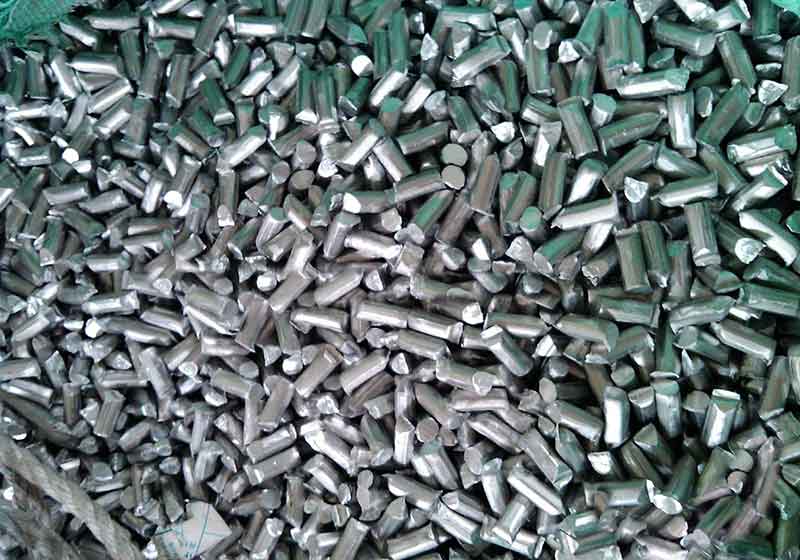
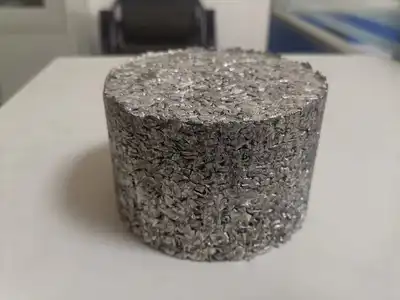
Aluminium granules are small, free-flowing particles produced by shredding, granulating, screening or other size-reduction processes. Typical sources include clean production offcuts, separated aluminium fractions and uniformly sized recycled metal. Although granules are easier to meter than long turnings, their low loose bulk density and large exposed surface area can still cause dust, scattering, oxidation and inefficient furnace charging.
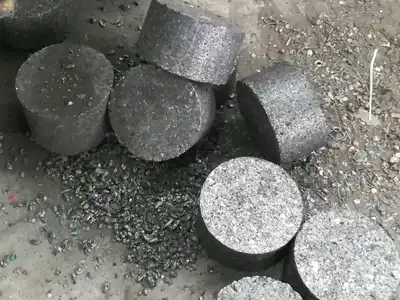
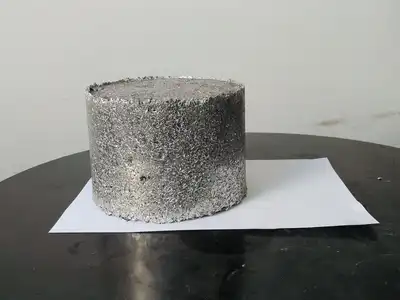
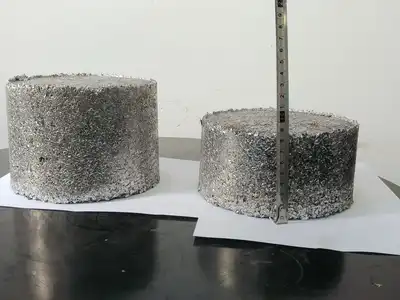
An aluminium granule briquetting machine applies high hydraulic pressure to form the particles into dense, consistent cylindrical briquettes. This process is designed for high-density compaction rather than large transport bales, making the finished blocks easier to collect, store, weigh, transport and feed into suitable remelting operations.
1. Effect After Briquetting:
2. What Aluminium Granules Are Suitable for Briquetting?
Briquetting is most effective when the feed is reasonably uniform, flowable and free from oversized objects. Suitable materials can include screened aluminium granules, shredded aluminium particles, short clean fragments and selected fine production residues. The final briquette strength depends on particle-size distribution, alloy, surface condition, contamination and moisture.
Particle size: the maximum and average granule dimensions must suit the feed opening, dosing system and compression chamber.
Material purity: steel, plastic, rubber, sand and other contaminants should be removed according to the remelting specification.
Moisture and fluid: excessive water or oil can affect feeding, briquette stability and downstream furnace performance.
Bulk behaviour: very light, dusty or irregular particles may require enclosed conveying, agitation or controlled screw feeding.
3. Why Briquette Aluminium Granules?
Increase bulk density: high-pressure compaction converts loose particles into compact blocks that require less storage and transport space.
Improve material handling: uniform briquettes are easier to collect, count, weigh, palletize and convey than loose granules.
Reduce scattering and dust: compact blocks help contain small particles during transfer, loading and housekeeping.
Support controlled furnace feeding: repeatable briquette dimensions allow more consistent dosing where the receiving furnace accepts compact feed.
Limit oxidation exposure: densification reduces the exposed surface area of loose fine material and may help reduce metal loss during suitable remelting processes.
Improve scrap consistency: sorted, clean and regularly formed briquettes are easier for recyclers and foundries to inspect and process.
4. How Does an Aluminium Granule Briquetting Machine Work?
Collection and screening
Granules are collected and screened so oversized pieces and unwanted contaminants do not enter the press.
Controlled storage
The prepared material enters a hopper fitted with agitation or anti-bridging devices when required.
Metered feeding
A screw, conveyor or dosing system delivers a repeatable quantity into the compression chamber.
Pre-compaction
Loose particles are distributed and pre-compressed to improve filling consistency.
High-pressure compression
A hydraulic ram applies controlled pressure and forms a dense cylindrical briquette.
Fluid drainage when applicable
Residual liquid released during compression is collected for treatment or reuse when the material condition requires it.
Automatic discharge
The finished briquette is discharged to a conveyor, collection bin or palletizing area, and the cycle repeats.
5. What Do Our Engineers Evaluate?
DILOYA engineers review representative samples or clear material data before selecting the briquetting system:
granule source, aluminium alloy and contamination level;
minimum, average and maximum particle size;
loose bulk density, moisture, oil content and flow behaviour;
required hourly or daily throughput and operating hours;
target briquette diameter, height, density and handling strength;
hopper capacity, feeding method, automation and line integration;
installation space, local voltage, drainage needs and downstream furnace requirements.
6. How to Choose a Suitable Aluminium Granule Briquetting Machine?
Machine selection should begin with the actual particle-size range and bulk density, not nominal hydraulic pressure alone. Fine, free-flowing granules may use a different dosing arrangement from lightweight or irregular fragments. Required capacity determines the chamber size, cycle frequency and feeding system, while the receiving recycler or foundry determines the acceptable briquette dimensions and density.
Send DILOYA a representative sample or material photos, particle-size data, bulk density, moisture or oil content, required output, preferred briquette size, installation space and local voltage. Our engineers will configure the hopper, feeder, compression chamber, hydraulic system, controls, drainage and discharge arrangement around the complete process.