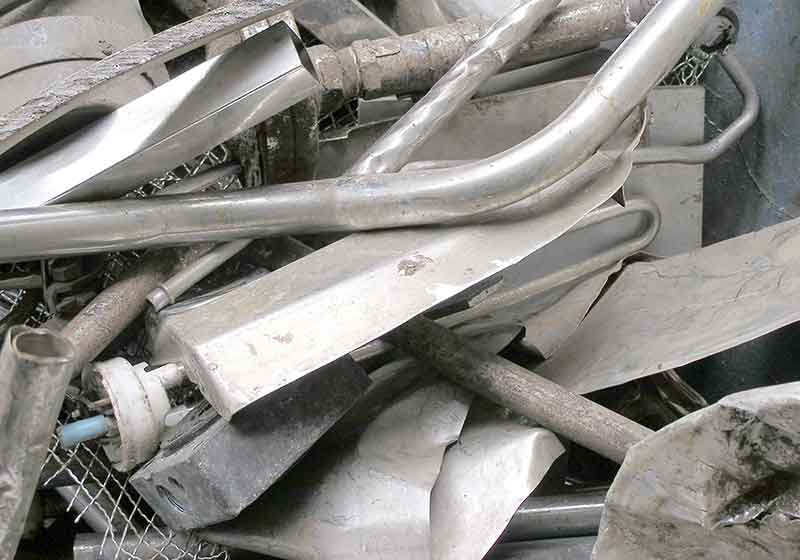
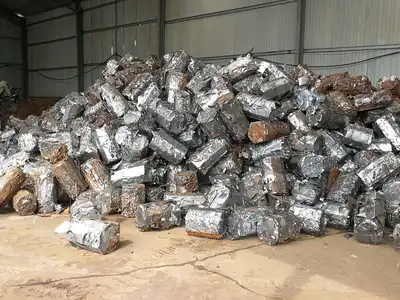
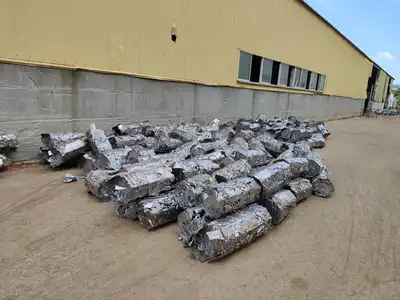
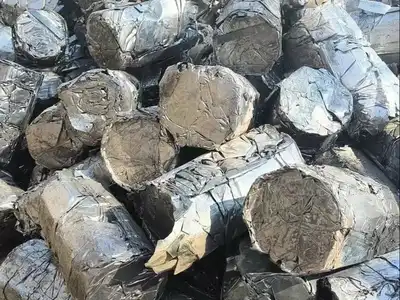
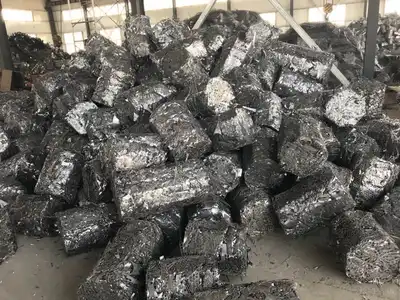
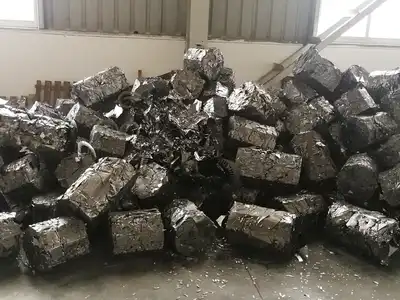
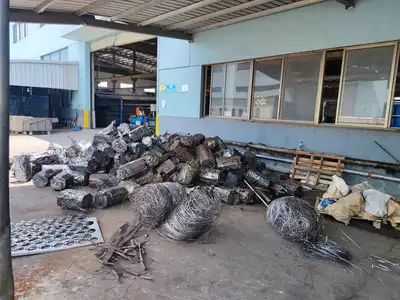
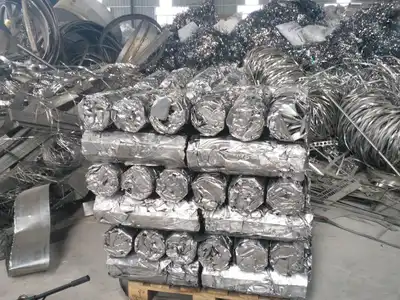
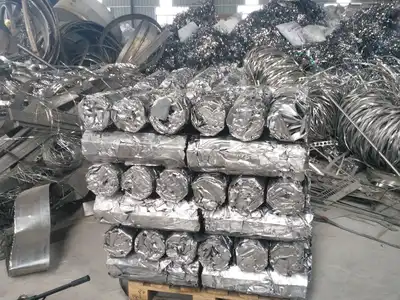
Stainless steel scrap includes clean sheet offcuts, punched skeletons, trimmed strip, fabrication remnants, wire, mesh and light formed components generated by stainless steel processing. These materials retain significant alloy value, but their low loose density, sharp edges and irregular shapes make uncompressed storage and transport inefficient.
DILOYA hydraulic metal balers compress sorted stainless steel scrap into dense, stable packages for storage, weighing and shipment to stainless recyclers and melting plants. This application is designed for baling only. It does not cover stainless turnings that require briquetting, or thick structural sections that may require cutting before compaction.
Stainless Steel Scrap After Baling
Which Stainless Steel Scrap Is Suitable?
Typical feed includes 304 or 316 sheet offcuts, press-shop skeletons, thin strips, kitchenware production waste, clean mesh, wire, light tube offcuts and sorted fabrication remnants. Material should be identified and separated by grade whenever the downstream buyer prices nickel, chromium and molybdenum content independently.
Closed vessels, gas cylinders, batteries, oily containers, sealed components and unknown process residues must not enter the chamber. Thick plate, long heavy pipe and solid bar may require size reduction or a different machine configuration. Fine stainless turnings behave differently from sheet and wire scrap and should be evaluated as a separate chip-recovery application.
Why Bale Stainless Steel Scrap?
- Preserve alloy value: controlled grade separation reduces dilution between stainless grades and carbon steel.
- Reduce occupied volume: loose sheet, wire and mesh become compact packages with a predictable footprint.
- Improve logistics: consistent bales simplify weighing, forklift handling, container planning and export shipment.
- Control sharp material: compression contains projecting edges and loose wire for safer storage and yard housekeeping.
- Support buyer inspection: repeatable bale size and documented material origin make quality checks more efficient.
Grade Control Before Compression
Baling improves handling but does not correct mixed chemistry. Austenitic grades such as 304 and 316, ferritic stainless, magnetic attachments and carbon-steel contamination should be separated according to the buyer's specification before loading. Handheld alloy analysis, magnet checks and source-based sorting can be incorporated into the receiving process.
Remove excessive rubber, plastic, insulation, oil, dirt and moisture. Clean feed protects resale value, reduces trapped contamination inside the bale and helps the receiving plant calculate a reliable metallic yield.
Recommended Baler Configuration
| Material condition | Configuration focus |
|---|
| Thin sheet and stamping skeletons | Wide feed box, secure lid control and multi-directional compression |
| Springy wire, mesh and long strip | Contained loading, effective pre-compression and controlled ram sequence |
| Mixed light fabrication remnants | Large chamber, wear-resistant liners and stable bale discharge |
| Continuous factory production | Conveyor or grab feeding, automatic cycling and repeatable bale dimensions |
How the Stainless Scrap Baling Process Works
- Identify and sort: separate stainless grades and remove unsafe or non-metallic contamination.
- Prepare the feed: reduce oversized pieces when necessary and distribute sheet, wire and small remnants evenly.
- Load the chamber: use a grab, conveyor or manual method suited to the volume and sharpness of the material.
- Pre-compress and contain: the lid or first ram controls spring-back and pushes the loose charge into the compression zone.
- Form the bale: the main and side rams apply sequenced pressure to create a stable package without unnecessary over-compression.
- Discharge and verify: inspect bale shape, loose edges, approximate weight, grade identification and safe lifting condition.
What DILOYA Engineers Evaluate
Machine selection starts with actual material data rather than nominal hydraulic force. DILOYA evaluates stainless grade, sheet thickness, wire diameter, maximum piece dimensions, loose bulk density, spring-back, contamination, hourly or daily volume, loading frequency, required bale size and weight, discharge direction, available floor space, local voltage and downstream buyer requirements.
Send representative material photos, grade information, maximum dimensions, required throughput, preferred bale specification and site layout. Our engineers will configure the chamber opening, ram arrangement, hydraulic power, controls, wear protection and discharge system for reliable stainless steel scrap baling.