Compact ADC12 Aluminium Chip Briquetting for a Korean Customer
A customer in Korea selected a DILOYA integrated briquetting line to process ADC12 aluminium die-cast chips. With a reported project capacity of 200–300 kg/hour, the line is intended to turn loose chips into compact briquettes while accommodating a production area with limited available floor space.
For this project, machine selection was not simply a question of output. The customer also needed a practical arrangement for feeding material, collecting finished briquettes and working around the equipment within a constrained workshop layout.
Project Overview
Equipment: Integrated aluminium chip briquetting line
Key requirement: A compact, integrated arrangement suited to limited production space.
The stated capacity is the range supplied for this project, not a guaranteed output for every ADC12 chip stream. Actual throughput depends on chip size and shape, material condition, feeding consistency, machine settings and operating conditions.
The Challenge: Loose Chips in a Limited Production Area
Loose die-cast aluminium chips are less convenient to organise than compact briquettes. Collection containers, material transfer and finished-product storage all compete for space around the production process. When the available area is small, an equipment layout must account for the complete material route rather than just the dimensions of the press.
The customer's priorities were to process ADC12 chips at the required rate, keep the equipment arrangement compact and provide a clear route from chip feeding to briquette collection. A compact configuration also needs accessible controls and sufficient clearance for safe operation and maintenance.
The Solution: An Integrated Briquetting Line
DILOYA selected an integrated design that brings the main briquetting functions together in a coordinated arrangement. Instead of treating feeding, compression, controls and discharge as unrelated pieces of equipment, the layout considers how these functions connect within the available working area.
This approach helps limit the need for widely separated equipment and repeated material transfers between stations. It is particularly useful when a customer wants a chip-processing system that fits alongside existing workshop activities. See the Integrated Briquetting Press for related equipment information.
Integrated does not mean that all surrounding space can be eliminated. The final installation must still allow for the feeding arrangement, chip containers, the briquette collection point, electrical connections, access routes and maintenance clearance. No fixed footprint or space-saving percentage is claimed for this project.
From ADC12 Chips to Finished Briquettes
The process begins with collecting the ADC12 chips and supplying them to the line in a controlled manner. The press compresses the material into briquettes, which are then discharged into a receiving container. Coordinating these steps helps the operator maintain a clear and organised workflow from the loose material to the finished packages.
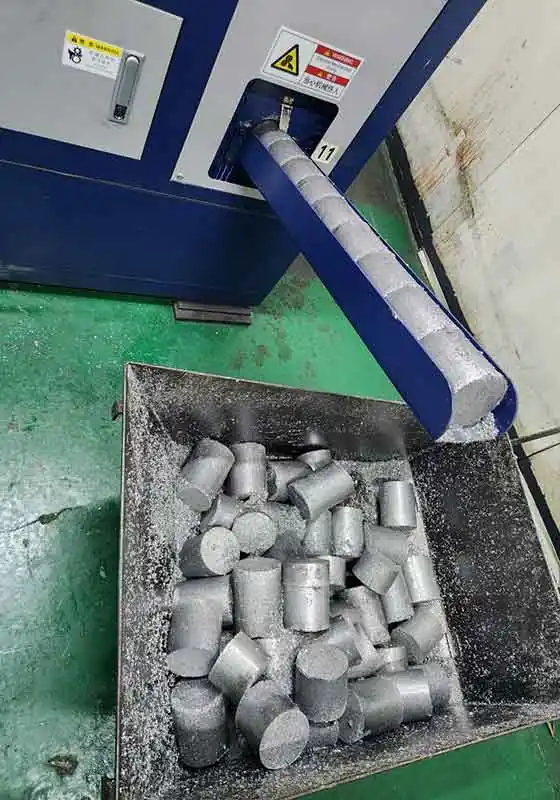
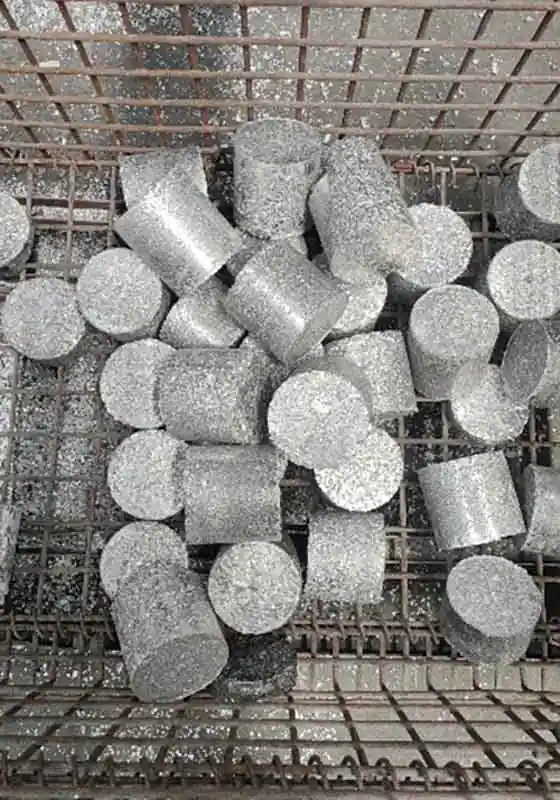
The first project photograph below shows briquettes leaving the machine along the discharge channel. The second shows the collected cylindrical briquettes. Together, they illustrate the output form of the customer's ADC12 chip-processing project.
Why the Integrated Design Fits This Project
Compact equipment arrangement: Connected functions can be planned as one material-processing route, helping the customer make practical use of a limited production area.
Capacity matched to the project: The reported 200–300 kg/hour range addresses this customer's ADC12 chip-processing requirement. Selection should always be checked against representative material and the intended operating conditions.
More organised collection: The discharged briquettes can be collected at a defined receiving point instead of leaving loose chips dispersed across several handling stages.
Convenient downstream handling: Converting loose chips into compact briquettes provides a more manageable material form for storage and subsequent recycling logistics. Specific transport savings, briquette density and recovery improvements have not been quantified for this case.
Planning an Aluminium Chip Briquetting Project?
Start with the actual material and the available space. Useful inputs include the ADC12 chip condition, chip dimensions, moisture or residual-fluid condition, required hourly output, receiving-container arrangement, available floor plan and local power supply. Where material preparation or fluid handling is needed, it should be assessed as part of the proposed configuration rather than assumed to be included.
Explore the Briquette Press range and the Integrated Briquetting Press, or contact DILOYA with your chip photographs and workshop layout for a project-specific assessment.