An Egyptian customer selected a High Output Alfalfa Hay Cutting Bagging Baler as an integrated, automatically controlled production line. The supplied project figures are 15 tonnes per hour and a bale weight of 480–500 kg. The line brings hay cutting, material transfer, compression and bagging into one coordinated production arrangement for large-format forage packages.
The commercial focus is high-volume handling and shipment preparation. Large, regular bales turn a bulky forage stream into units that can be organized for storage and mechanically handled during dispatch. Production efficiency depends on the complete line working together, from incoming hay to the removal of finished bales.
Egypt Project Specifications
Customer location: Egypt.
Equipment: High Output Alfalfa Hay Cutting Bagging Baler.
Material: alfalfa hay.
Stated production capacity: 15 tonnes per hour.
Stated bale weight: 480–500 kg per bale.
Production arrangement: integrated line with fully automatic control.
Reported container arrangement: 60 bales in a 40-foot high-cube container.
Reported cargo weight: 27–29 tonnes per container, subject to reconciliation with actual bale weights and the approved loading plan.
From Hay Cutting To A Large Bagged Bale
The process begins with material prepared for the cutting stage. Cutting brings the hay into the form required by the configured line, after which it is transferred to the compression and bagging stages. The baler consolidates the charge into a large rectangular unit and transfers it through the packing outlet. Finished bales then move to the handling area.
The exact cutting length, feed arrangement, packaging material and closure method were not provided for this project. These are configuration details to confirm, not values that can be inferred from the machine name. Cutting and compression prepare a handling format; they do not establish the nutritional grade of the incoming forage.
Automatic Control Across The Production Line
The customer specified an integrated line with fully automatic control. Coordinating the connected stages helps maintain material flow through cutting, transfer, compression and discharge, reducing the need to treat each stage as a separate manual task.
Automatic control does not remove the need for supervision, material supply, package checks and planned maintenance. At this output level, finished-bale removal must also be coordinated with production. The scope of automated bag placement, closure and downstream stacking should be confirmed from the actual equipment list rather than assumed.
480–500 kg Bales For Bulk Forage Handling
The stated bale-weight range is 480–500 kg. This large-format package is intended for mechanical handling and bulk logistics, rather than manual carrying or small retail packs. Uniform bale geometry can help organize storage and loading, provided that the package remains stable and the selected handling equipment is appropriate.
The supplied photos show large alfalfa bales in storage, on a trailer and near handling equipment. These illustrate package form and logistics contexts. They are not independent proof of a particular shipment weight, loading approval or the identity of every installation shown.
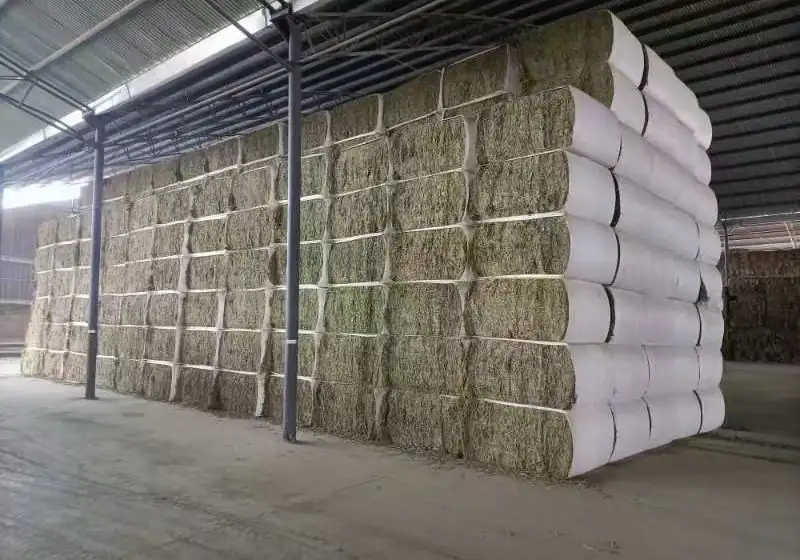
Large-format alfalfa bale example in storage.
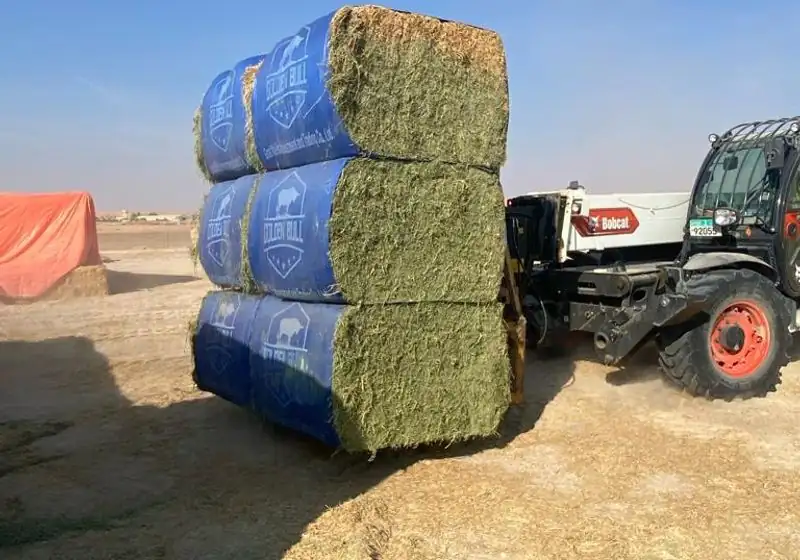
Mechanical-handling example supplied with the project.
15 Tonnes Per Hour: Plan The Whole Material Flow
The stated capacity is 15 tonnes per hour. At bale weights of 480–500 kg, this is arithmetically equivalent to approximately 30–31 bales per hour. This is a planning calculation from the supplied figures, not a separately measured cycle-rate result.
To sustain the intended output, incoming hay supply, cutting capacity, transfer, compression, packing and finished-bale removal need to support the same production objective. Interruptions in one stage affect the usable output of the line. Material condition and the agreed bale specification should therefore be included in any production test.
Container Loading: Keep Bale Count And Cargo Weight Separate
The customer supplied a loading arrangement of 60 bales in a 40-foot high-cube container and a reported cargo-weight range of 27–29 tonnes per container. These are retained as separate project-reported figures, not presented as interchangeable specifications.
The figures require reconciliation: 60 bales at 480–500 kg each calculate to 28.8–30.0 tonnes. The full calculated range does not match the reported 27–29 tonnes. Actual bale weights, the number loaded and the shipment weighing basis must be checked before confirming a final loading plan.
The 60-bale arrangement also depends on actual bale dimensions and loading geometry, which were not supplied. Container suitability and permissible shipment weight must be confirmed for the particular equipment and transport arrangement. A reported count should not be treated as unconditional loading authorization.
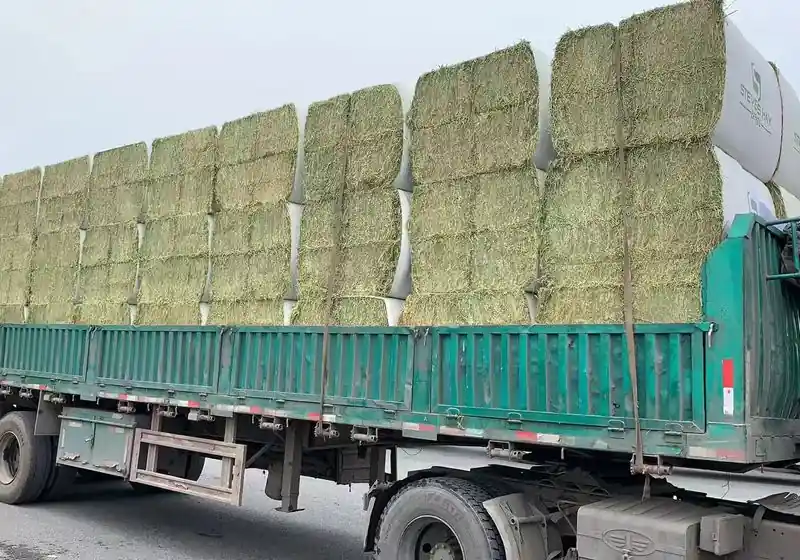
Transport example: the photograph does not verify payload or a 60-bale container arrangement.
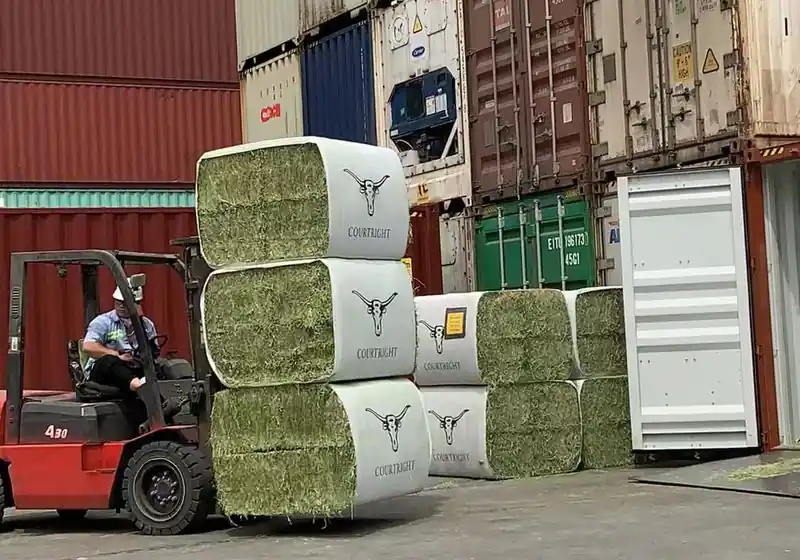
Container-area handling example; final bale count and cargo weight require shipment-specific checks.
Why Integrate Cutting, Compression And Bagging?
A coordinated production route: linking the processing stages supports a continuous workflow instead of repeated movement between standalone tasks.
A defined handling unit: compressing forage into large bales makes stock easier to identify, organize and move with suitable equipment.
More structured shipment planning: regular packages provide a basis for checking loading geometry, package counts and weighed cargo quantities.
High-volume production: the stated 15-tonne-per-hour capacity addresses bulk forage-packaging demand. No numerical labor saving, freight saving or compression ratio has been provided, so these are not claimed as measured project results.
Customer Case FAQ
What Is The Stated Output And Bale Weight?
The customer supplied 15 tonnes per hour and 480–500 kg per bale for this integrated alfalfa hay cutting and bagging line.
Is This An Automatically Controlled Production Line?
Yes. The supplied description specifies an integrated production line with fully automatic control. Individual downstream automation features should be confirmed in the actual line scope.
Can The Container Figures Be Used Without Checking?
No. The reported 60 bales and 27–29 tonnes need to be reconciled with the stated bale-weight range. Sixty bales at 480–500 kg calculate to 28.8–30.0 tonnes, and the final plan must use actual shipment data.
What Should Be Confirmed For A Similar Project?
Confirm representative hay, cutting requirements, bale weight and dimensions, packaging and closure, sustained line output, handling equipment and the intended loading arrangement. Verify container and route constraints before committing to a cargo quantity.
