A customer in Singapore uses a Horizontal Steel Bar Container Shear to process heavy ferrous scrap, including waste reinforcing bars, heavy steel scrap, angle steel and I-beams. The machine combines a horizontal box-style layout and large feed opening with PLC fully automatic control and remote control. The reported processing output for the application is 10–15 tonnes per hour.
The project emphasizes efficient heavy-scrap cutting within a compact equipment arrangement. The receiving chamber, controlled cutting sequence and defined discharge area support an organized yard workflow, while the complete site layout still needs appropriate loading, collection and service space.
Singapore Heavy Scrap Shearing Project At A Glance
Customer location: Singapore.
Equipment: Horizontal Steel Bar Container Shear, also known as a horizontal box shear.
Materials: waste rebar, heavy ferrous scrap, angle steel, I-beams and suitable structural steel scrap.
Layout: horizontal box-style receiving and cutting arrangement.
Feeding feature: large material opening.
Reported hourly output: 10–15 t/hour.
Controls: PLC fully automatic control and remote control.
Project priorities: high cutting productivity and efficient use of the available equipment area.
The Challenge: Preparing Bulky And Irregular Heavy Steel Scrap
Waste reinforcing bars and structural steel can arrive as long pieces, tangled bundles or irregular sections. Before further recycling, the customer needs to reduce suitable material into smaller pieces that can be collected and handled through the next stage. A workable solution must account for the material's shape as well as its mass.
Heavy scrap is not one uniform grade or section. Rebar diameter, beam profile, wall thickness, alloy and attached material influence the cutting requirement. The stated material list describes this application; it is not approval to load every size or grade of rebar, angle or I-beam into the machine unchanged.
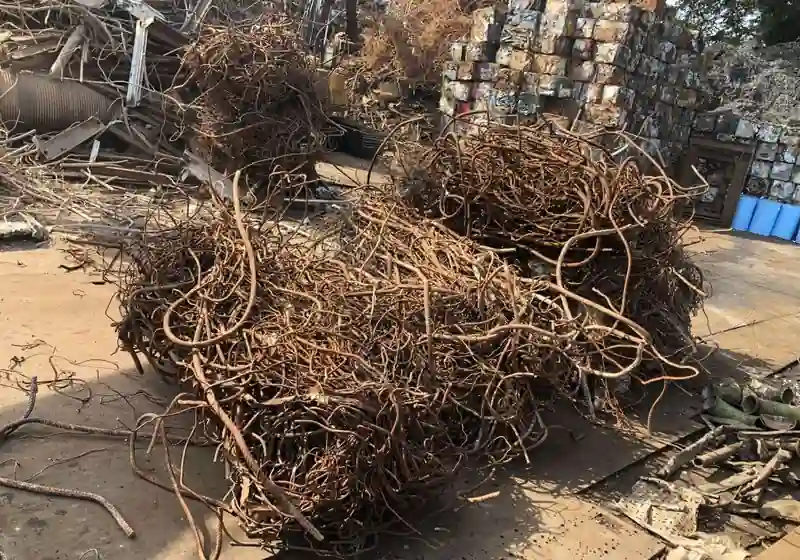
Incoming-material context: tangled waste rebar and heavy ferrous scrap require assessment before processing.
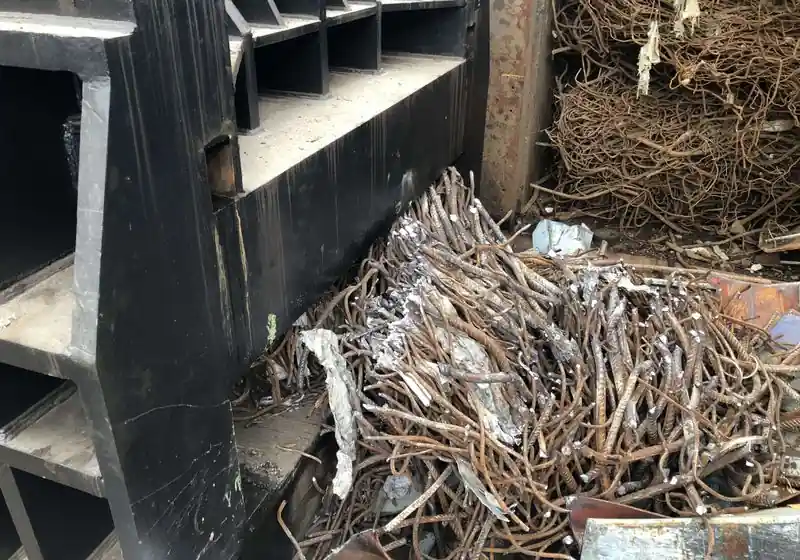
Processing detail: shortened steel pieces collected beside the shear outlet.
Horizontal Box Design With A Large Feed Opening
The Horizontal Container Shear uses a box-style receiving chamber to organize the material charge before cutting. Compared with a piece-by-piece cutting station, this arrangement provides a defined space for suitable bulky scrap and connects loading with the configured internal processing sequence.
A large feed opening helps accommodate the intended scrap presentation, but opening size alone does not determine maximum cutting capacity. The chamber dimensions, permitted material section, cutting force and handling arrangement must be assessed together. No numerical opening dimensions, cutting-force rating or maximum beam section have been supplied for this Singapore case.
Process Overview: Loading, Conditioning, Cutting And Discharge
Material preparation and loading: the incoming scrap is checked against the permitted specification and presented to the receiving chamber using the approved loading arrangement. Unsuitable inclusions and oversized pieces require assessment before they enter the process.
Controlled material advance: the configured machine sequence contains and conditions the charge for the cutting stage. The exact compression, pusher or other advance arrangement depends on the supplied model and should not be inferred from the box-shaped exterior alone.
Hydraulic shearing: the cutting system reduces compatible steel scrap into shorter pieces according to the agreed configuration and cut requirement. Feed geometry and required finished length affect the work involved in each cycle.
Discharge and collection: cut material leaves through the designated outlet and is collected for subsequent handling. A clear collection plan prevents finished pieces from becoming a bottleneck to the complete process. This overview describes the production concept, not step-by-step operating instructions.
Reported Production Of 10–15 Tonnes Per Hour
The supplied output range describes the customer's reported heavy-scrap application. It is a mass-throughput figure, not a cutting-frequency specification, and it should not be treated as guaranteed production for every scrap mix. Rebar bundles, heavy plate and structural sections can create different loading and cutting conditions.
For another project, verify performance using representative feed over an agreed operating period. Record the material mix, maximum sections, cut-length requirement, mass processed and handling steps included. Loading consistency, material preparation and timely removal of cut pieces all influence useful hourly output.
PLC Fully Automatic Control And Remote Control
The supplied configuration includes PLC fully automatic control for the configured processing sequence and remote control for the functions authorized by the machine design. This supports coordinated repeated operation and allows the designated operating position to be considered as part of the yard layout.
Remote control is not a substitute for guarding, controlled access or supervision. It does not authorize personnel to remain in loading, cutting or discharge danger zones. Operating modes, interlocks, stopping and restart conditions must follow the supplied machine documentation. No remote operating range, internet-monitoring feature or unattended-operation capability has been specified.
Cut Steel And Rebar Examples
The supplied photographs show shortened reinforcing bars and mixed structural steel near the discharge area. They illustrate the cutting result and collection context without assigning an unreported finished length, piece weight or material grade to a photographed sample.
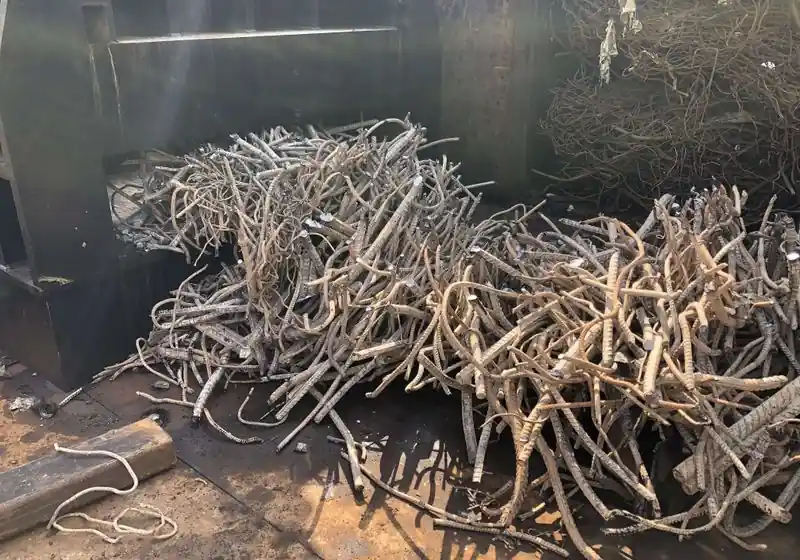
Cut-material example: reinforcing bars reduced to shorter pieces near the discharge area.

Cut-material example: rebar and structural steel pieces after size reduction.
Compact Equipment Layout And Yard Planning
The horizontal box arrangement is intended to use the equipment area efficiently while handling substantial scrap volumes. For this customer, a compact installation and productive cutting workflow are important parts of the selection. No measured footprint or percentage space saving has been supplied, so neither is invented.
The working area is larger than the machine's base alone. It must include the loading route, incoming stock, discharge collection, hydraulic-system access and maintenance clearance. A compact machine still needs a site plan that keeps people, material movement and equipment access appropriately organized.
Specifying A Similar Heavy-Scrap Shearing Project
Provide photographs of the intended feed, maximum rebar diameter, structural-section dimensions, material grades, daily quantities and required finished length. Include operating hours, available power, loading equipment and a drawing of the receiving and discharge areas. These details allow the machine and its surrounding workflow to be evaluated together.
The Alligator Shear For Aluminium Ingot Cutting In South Africa case describes a different material and cutting arrangement. Its stroke rate and hourly output should not be transferred to this heavy-ferrous container-shear application.
Customer Case FAQ
What Materials Are Included In This Singapore Application?
The reported feed includes waste rebar, heavy ferrous scrap, angle steel, I-beams and suitable structural steel scrap. Actual sections and grades must stay within the selected machine's specification.
What Output Is Reported?
The customer application reports 10–15 tonnes per hour. A comparable requirement should be checked with representative material, agreed cut length and a defined measurement period.
Does A Large Opening Mean Every Heavy Beam Can Be Cut?
No. An opening accommodates material presentation; cutting suitability also depends on section, strength, blade arrangement and rated force. Maximum sizes have not been supplied for this case.
What Control Features Are Specified?
The configuration includes PLC fully automatic control and remote control. The actual authorized functions and protective sequence are defined by the supplied machine documentation.
