A customer in Indonesia selected a Three Rams Bagging Baler For Corncob Granules, with stated production capacity of 4–6 tonnes per hour. The purpose is to turn loose granules into compact, contained packages that are easier to store, move and dispatch. Instead of repeatedly handling a free-flowing bulk product, the customer can organize finished material as individual bagged units.
This application is about packaging prepared corncob granules, not processing whole cobs into granules or manufacturing fuel pellets. The three-ram baler compresses the incoming material and transfers it into the selected bagging arrangement. Upstream preparation and the specification of the granules remain separate parts of the production process.
Indonesia Project At A Glance
Customer location: Indonesia.
Equipment: Three Rams Bagging Baler.
Material: prepared corncob granules.
Stated output: 4–6 tonnes per hour.
Packaging objective: compact, contained units for handling, warehouse organization and shipment.
Package weight and dimensions: to be confirmed for the individual order.
Why Bag Corncob Granules?
Loose granules need containment throughout their journey from production to the buyer. Open piles or repeated transfers can make counting, collecting and loading finished stock awkward. Simple loose filling provides containment, while compression bagging adds a more regular package form where the material and packaging specification permit it.
For this project, the packaging goal is to bring the material into a manageable unit before it enters storage and distribution. The bag retains the granules; compression reduces void space within the charge. The resulting package is intended to make subsequent logistics more organized, not to change the product's composition or guarantee a particular end-use performance.
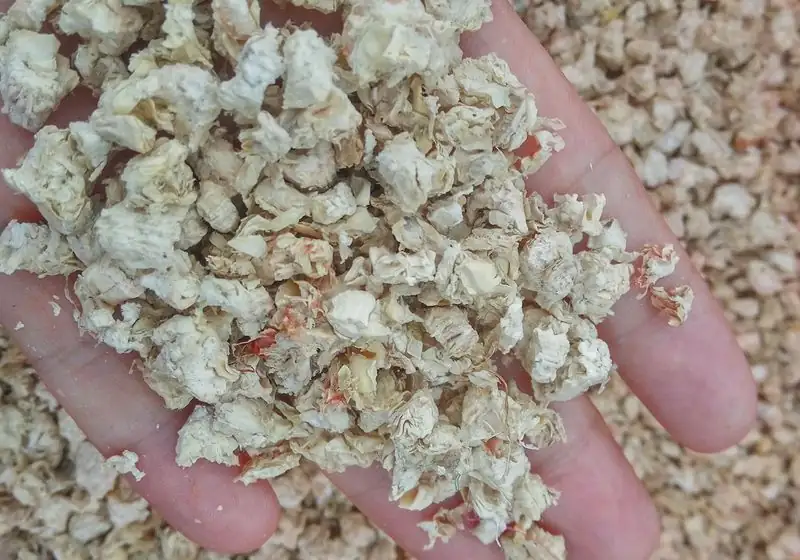
Material example: prepared corncob granules before compression and bagging.
What The Three-Ram Design Does
The Three Rams Bagging Baler uses staged hydraulic compression to control the charge and form a compact package before discharge. Multiple pressing actions help bring a loose volume into the configured package shape. The compression sequence and discharge arrangement are matched to the particular machine, material and bag specification.
At a process level, prepared granules are delivered to the feeding arrangement, introduced into the chamber, compressed and transferred into a suitable bag at the outlet. The package is then closed and checked before being moved to the finished-product area. The main photograph shows the baler with an inclined feed arrangement; the supporting photographs show bagged packages and the packing station.
The supplied project information does not specify a control-system type, automatic bag fitting or automatic sealing. Those features should be confirmed from the actual equipment scope rather than assumed from the three-ram name.
The Main Packaging Advantages
1. More Orderly Use Of Storage Space
A compact package presents a more regular unit than a loose pile or a loosely filled sack. Packages can be arranged into batches and planned around the available warehouse layout. Actual stack height and pallet arrangement depend on bag strength, package stability and the approved handling method.
2. Better Containment And Less Loose Material During Handling
A properly closed, suitable bag helps keep granules together during normal movement and reduces opportunities for product to spill from an open container. This benefit depends on the bag and closure remaining intact. Bagging does not eliminate dust at the feeding point or remove the need for appropriate housekeeping.
3. Simpler Movement Between Production And Dispatch
Individual packages make it easier to transfer a defined unit from the packing station into storage and then to the loading area. Handling can be organized around the selected package size and available equipment. A package should not be assumed suitable for manual lifting merely because it is bagged; its actual weight determines the required handling arrangement.
4. A More Consistent Basis For Loading And Transport
Reducing loose volume and producing a regular package shape can help use vehicle or container space more effectively when the shipment is volume-limited. The practical result must still be checked against payload limits, package dimensions and loading stability. No freight-saving percentage or compression ratio has been supplied for this customer.
5. Clearer Stock And Order Identification
Bagged units provide a convenient basis for batch labels, product-grade identification and dispatch records. Combining package counts with verified net weights supports order preparation. The baler itself is not a substitute for checking the quantity and grade that the customer has ordered.
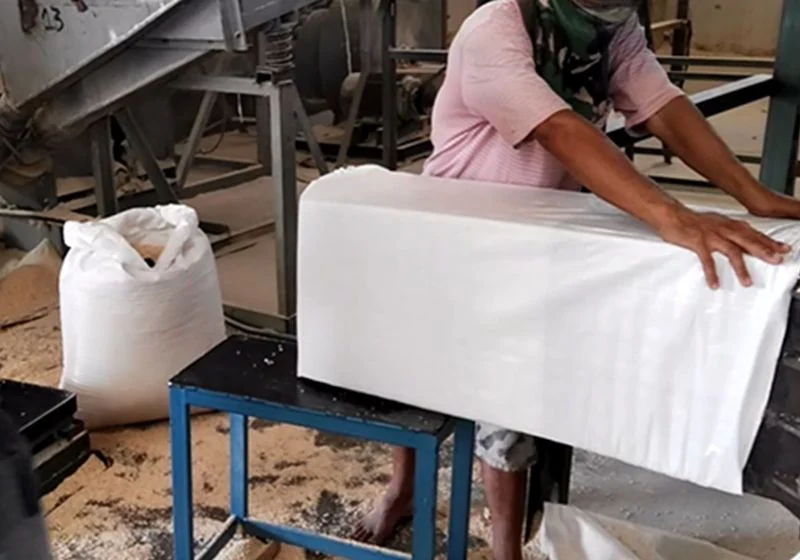
Packing-stage example: a contained package at the discharge station.
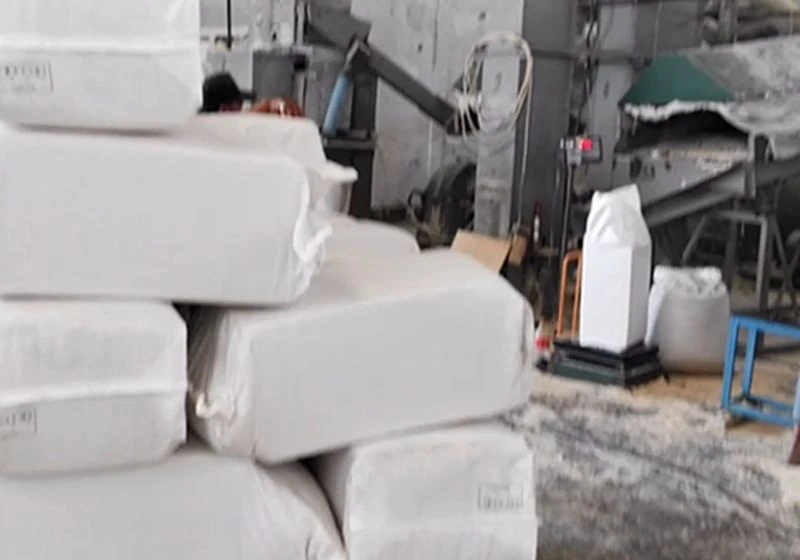
Finished-package example: contained units arranged for subsequent handling.
Understanding The 4–6 Tonnes-Per-Hour Capacity
The stated project output is 4–6 tonnes per hour, expressed as material throughput rather than a count of packages. The number of bags produced in an hour also depends on net bag weight, which has not been provided. A bag-per-hour figure is therefore not inferred for this case.
Sustained output depends on feed consistency, granule condition, the selected package specification and the complete packing workflow. Feeding, compression, bag supply, closure and removal of finished packages must work together. A high-capacity baler still needs a production arrangement capable of supporting the intended material flow.
Keep The Granule Specification In Focus
The desired result is a practical transport package with material acceptable to the buyer after opening. Compression settings should therefore be assessed with representative granules and the intended bag. The specification should account for particle-size requirements, acceptable fines, package integrity and the way the material will be released for use.
Bagging does not dry, screen, sterilize or waterproof the product. Any required upstream preparation remains separate, and protection during storage depends on material condition, bag properties, closure and the storage environment. The photographs illustrate the supplied packaging examples; they do not establish a package weight, final density or certification.
A Logistics-Focused Packaging Solution
The Indonesian customer's three-ram bagging application places the emphasis on what happens after granule preparation: containing the material, organizing stock and making shipment handling more straightforward. The stated 4–6 tonnes-per-hour capacity addresses production scale, while the package specification determines how those tonnes become practical units for the warehouse and the buyer.
Customer Case FAQ
What Is The Main Purpose Of Baling Corncob Granules?
To compress and contain loose granules in manageable bagged units, supporting organized storage, handling and transport.
What Is The Stated Throughput?
The supplied project capacity is 4–6 tonnes per hour. Sustained output depends on the material, package specification and supporting feeding and packing operations.
Does This Machine Produce Corncob Pellets?
No. This case concerns compression and bagging of prepared corncob granules. Granulation and pellet manufacturing are separate processes.
What Is Needed To Evaluate A Similar Installation?
Provide representative granules, particle-size requirements, target net package weight and dimensions, bag and closure requirements, required throughput and the intended storage and loading arrangement.
