A suitable metal baler must satisfy three requirements together: the incoming scrap must be loadable and suitable for compression, the chamber must support an efficient loading process, and the finished bale must meet the receiving customer's specification. Selecting only by pressing force, or simply choosing the largest box, can overlook the real constraints of the job.
This practical selection guide explains how to connect material size, press chamber dimensions and bale requirements. The calculations are illustrative planning examples, not DILOYA machine ratings or guaranteed production results.
1. Start with the required bale, then work back to the incoming scrap
Before comparing machines, ask the scrap buyer, foundry or steel mill what it can actually receive. Confirm the accepted material grade, maximum package dimensions, bale weight range, density where specified, contamination limits and handling requirements. A bale that is easy to produce is not necessarily a bale that the customer accepts.
Ask whether dimensions are nominal or maximum limits, how tolerances are checked and whether the bale must remain intact during loading and unloading. Spring-back after discharge may affect measured dimensions. Obtain the acceptance conditions in writing rather than relying on the appearance of a sample bale.
Trade specifications can be a useful reference, but they are grade-specific. For example, ReMA's ISRI specification for No. 1 bundles combines material restrictions with package and density requirements. It should not be applied as a universal standard for every steel, aluminium or copper bale. Confirm the applicable specification and any agreed variations with the actual receiver.
2. Describe the material beyond its longest dimension
A long, thin sheet and a short, solid steel section can create very different demands. The first may fold under compression; the second may be unsuitable for the proposed baler even though it fits inside the box. Material length alone is not enough to establish suitability.
> Metal and grade: identify steel, stainless steel, aluminium, copper or other alloys, and whether they are kept separate.
> Typical and maximum dimensions: record length, width and height, including bent sections, loops and awkward protrusions.
> Thickness and form: distinguish thin sheet, stampings, profiles, wire, cans, plate, bar and solid pieces.
> Loose bulk density: describe how much volume a known mass occupies under a repeatable loading method.
> Compressibility and spring-back: note hollow, springy, tangled or nested material rather than treating all scrap as uniform feed.
> Condition: report oil, moisture, coatings, non-metallic attachments and other contamination.
Photograph ordinary loads as well as the largest and most difficult pieces. A selection based only on unusually clean, short offcuts may not represent daily operation. Keep different material streams separate during evaluation when their behaviour differs significantly.
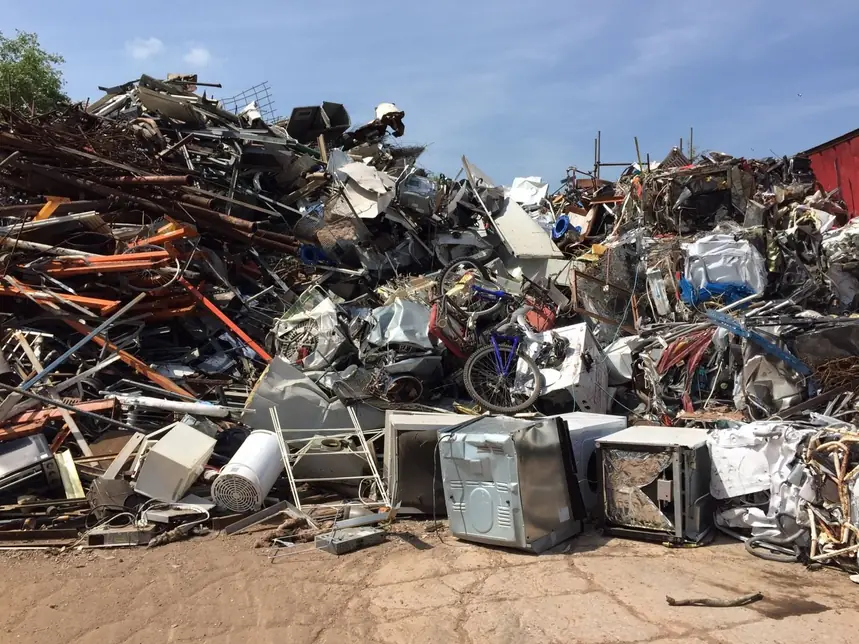
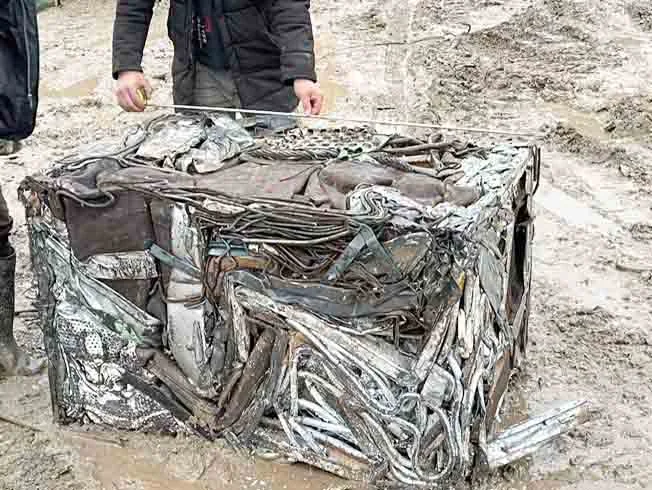
Before baling (left) · After baling (right). These photographs show separate illustrative examples, not a documented before-and-after trial of the same batch. Incoming scrap varies in size, shape and contamination; sorting and removal of unsuitable components must precede loading. Check each discharged bale's external dimensions and weight separately. No specific dimension, weight or density is established by the photographs.
3. Distinguish the loading opening, chamber and finished bale
These dimensions describe different parts of the process and must not be used interchangeably:
Loading opening
What it describes: The access through which scrap enters
What to confirm: Clear opening, loading height and space for the grab, forklift or loading device
Usable chamber dimensions
What it describes: The internal space available for an approved load at the specified starting position
What to confirm: Internal length, width, depth, obstructions and permitted loading level
Finished bale dimensions
What it describes: The compacted package after the pressing sequence and discharge
What to confirm: Cross-section, length, tolerances and measurement after release
Installation envelope
What it describes: The complete space needed to operate and service the machine
What to confirm: Open lid and doors, loading access, discharge clearance and maintenance space
A catalogue's chamber volume is not automatically the usable charge volume for every material. The lid, compression sequence, starting positions and allowable loading level must be considered. Confirm the drawing's dimension convention; do not assume every supplier uses length, width and height in the same order.
On some designs the bale cross-section is set mainly by the pressing arrangement, while bale length or weight can vary within an approved operating range. That does not mean every machine can make any requested bale size. Obtain the proposed finished-bale dimensions separately from the chamber dimensions.
4. Match the chamber to the real loading method
The largest piece should enter through the actual loading opening and fit within the approved loading envelope without obstructing the closing or pressing sequence. Do not assume that a long piece can be loaded diagonally or folded by the lid unless the manufacturer has approved that material and loading method.
Oversized feed may require sorting, cutting or other preparation before baling. A baler equipped with a cutting feature still has limits on material form, section and thickness; a cutting edge is not permission to process arbitrary heavy scrap.
For bulky sheet scrap, a larger chamber may reduce loading interventions. For small, dense offcuts, additional chamber volume may offer less benefit. The objective is not maximum box size: it is a loading arrangement that supports the required bale and workload.
Discuss material and discharge requirements when evaluating a Side Push-Out Metal Baler, Three Rams Shear Baler or Heavy Duty Metal Baler. A product family name is a starting point, not a substitute for confirming the particular configuration.
5. Check bale size, weight and density together
For an approximately rectangular bale, the relationship is:
Bale volume (m³) = length (m) × width (m) × height (m)
Average bulk density (kg/m³) = measured bale mass (kg) ÷ external bale volume (m³)
For example, a bale measuring 0.40 × 0.40 × 0.50 m has an external volume of 0.08 m³. If it weighs 120 kg, its calculated average density is 1,500 kg/m³. These are illustrative figures only, not a recommended density for all scrap or a performance promise for a particular machine.
At the same external dimensions, two materials may produce different bale weights. Conversely, the same target weight can require different package volumes. Density also does not prove that a bale has the required chemistry, cleanliness or handling integrity.
State which requirements are fixed and which can be adjusted. If the buyer fixes the cross-section and sets a maximum weight, the achievable bale length may need to be agreed. If length is fixed too, the material and pressing results must be tested against all three constraints.
6. Evaluate throughput as a complete working cycle
Pressing force is not a throughput rating. Sustained output depends on material behaviour, loading time, approved charge size, the pressing sequence, discharge, bale removal and normal interruptions.
Required average output = daily scrap mass ÷ usable baling hours. A yard processing 24 tonnes in six usable hours needs an average of 4 t/h. This workload calculation is not proof that a particular machine can achieve it; the proposed system must be evaluated on representative material and a defined operating basis.
A second planning check is average bale mass × completed bales per hour. If an illustrative operation produces 120 kg bales at 20 completed bales per hour, the calculated output is 2.4 t/h. Do not combine a best-case bale weight with a cycle time measured on a different material or a pressing-only cycle that excludes loading.
Smaller bales may suit downstream handling but require more discharge and removal operations for the same tonnage. Larger bales may reduce package count but exceed the receiver's or handling equipment's limits. Confirm the complete operating balance rather than optimising one figure in isolation.
7. Use a practical matching checklist
Long or irregular sheet offcuts
Main selection question: Can the material enter and be loaded within the approved envelope?
Next check: Opening dimensions, loading trials and any required preparation
Bulky, lightweight scrap
Main selection question: Does loose volume make loading the limiting step?
Next check: Usable charge volume, feed consistency and complete-cycle output
Thick plate, solid bar or heavy sections
Main selection question: Is the material suitable for this baler at all?
Next check: Manufacturer approval; assess shearing or other preparation where required
Springy wire or profiles
Main selection question: Will the discharged bale meet size and integrity requirements?
Next check: Spring-back and handling behaviour on representative samples
A strict buyer-specified package
Main selection question: Can dimensions, weight and material quality be achieved together?
Next check: Agreed acceptance criteria and a measured trial
A high daily tonnage target
Main selection question: Can loading, pressing and bale removal sustain the workload?
Next check: A timed operating trial with the full handling arrangement
Where heavy scrap is not suitable for the proposed baler, review the Hydraulic Shear range as a separate processing option. Do not force an unsuitable feed into a machine simply because its chamber looks large enough.
8. Confirm the match through a representative material trial
Agree the trial material, operating configuration and acceptance method before the test. Record the incoming dimensions and thickness range, loose material condition, loading method, bale dimensions after discharge, individual bale weights and completed output over a meaningful operating period.
Watch for repeated repositioning, bridging, material protrusion, inconsistent bale length and delays during bale removal. A successful short demonstration should not be presented as proof of sustained shift output without accounting for the normal workflow.
Assess bale integrity using an agreed handling method appropriate to the site. Never improvise a test that exposes people to moving machinery or unstable packages. Loading, clearing obstructions and maintenance must follow the machine's approved instructions and site procedures.
9. What to send when requesting a metal baler proposal
1> Material names or grades, plus clear photographs of typical and maximum-size pieces.
2> Typical and maximum length, width, height and thickness or section.
3> Daily tonnage, peak demand and the hours actually available for baling.
4> Loose bulk density, if measured, with the method used.
5> Required bale dimensions, weight range, density where specified and buyer acceptance conditions.
6> Loading equipment, loading height and planned operator involvement.
7> Discharge direction, bale handling equipment and storage or transport arrangement.
8> Site layout, access, electrical supply and any preparation equipment already installed.
Send the buyer's written specification where available. A clear material-and-bale brief helps DILOYA assess the chamber, pressing arrangement and loading method as one system, rather than recommending a machine from pressing force alone.
FAQ
Does a larger chamber always mean higher output?
No. A larger chamber may reduce the number of loading events for bulky scrap, but that advantage matters only if the press can process the charge and the yard can remove finished bales at the required rate. Filling an oversized chamber unevenly or waiting for loading equipment can erase the apparent benefit. Compare accepted tonnes over the complete cycle using the same feed and bale specification; chamber volume and an unloaded stroke time are not enough.
Can the same baler produce identical-weight bales from steel and aluminium?
Not from chamber size alone. Steel and aluminium loads differ in material density, packing and elastic recovery, so an equal external bale size does not establish equal mass. Specify each required package separately and use representative trials within the machine's approved settings. If the commercial requirement is a narrow weight range, define how accepted bales will be weighed rather than assuming that a visually full chamber gives a repeatable charge.
The case Automatic Aluminium UBC Shear Baler illustrates a defined aluminium-can application; its operating results do not establish performance for steel scrap.
Is it enough to provide the largest scrap length?
Length is only one part of the feed envelope. Width, height, plate or wall thickness, section strength and awkward projections determine whether the piece can be loaded and processed appropriately. A tube's outside size does not describe its wall, and a folded sheet may present a different local duty from a flat one. Provide photos and measurements of the most demanding normal pieces, not only an average pile.
The best match connects incoming scrap, the loading process and an accepted finished bale. Contact DILOYA with those conditions for a project-specific assessment.