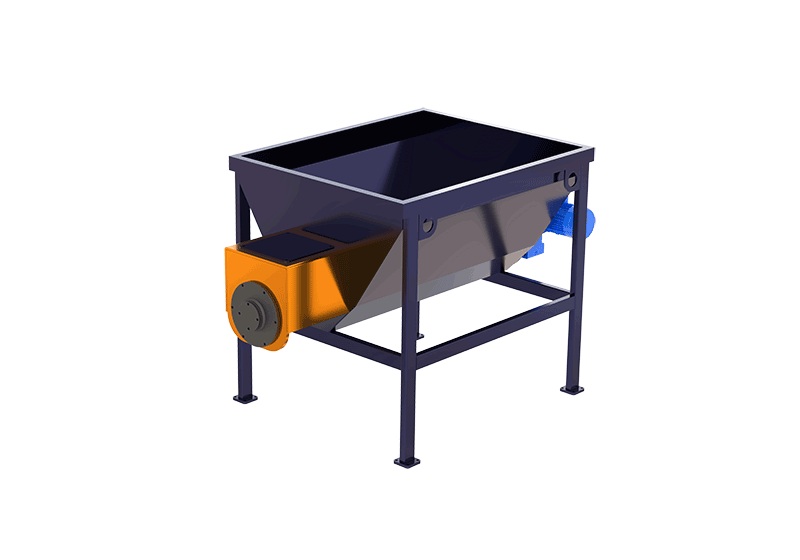
Buffer storage and screw feeding in one unit
The DILOYA Storage Screw Hopper stores a working reserve of suitable short metal chips and conveys them towards a matched briquetting-machine feeding point. It combines a receiving hopper with screw transfer so material collection and press feeding can operate on a more coordinated schedule.
Instead of repeatedly adding a small quantity whenever the press needs material, operators can replenish a suitably sized hopper at practical intervals. The screw then supplies chips at a selected rate. Actual replenishment frequency depends on usable hopper volume, chip bulk density and the press's sustained material demand.
Parameter:
| Model | SH1612 | SH2014 | SH2520 |
| Power | 2.2kw | 3.7kw | 2x3.7kw |
| Volume | 1.5m3 | 2.5m3 | 4m3 |
| Machine Size | 2200x1350x1630mm | 2600x1720x1850mm | 3200x2200x2100mm |
| Machine Weight | 1150kg | 1460kg | 2360kg |
Variable-frequency speed control
The screw drive uses variable-frequency control so its operating speed can be adjusted within the approved range. This provides a practical way to change the delivery rate when matching the hopper to briquetting machines with different production requirements.
A higher screw speed generally increases conveying potential, while a lower speed reduces it. Actual mass flow is not determined by speed alone: screw geometry, fill condition, chip shape, bulk density and material-flow behaviour all influence how much metal is delivered.
Variable-frequency adjustment does not by itself make the hopper a precision weighing or mass-dosing system. If a project requires measured delivery or closed-loop feed control, the necessary sensing and control arrangements must be specified separately.
Suitable short metal chips
Typical applications include suitable short steel and iron chips, aluminium chips, copper chips and other prepared machining swarf. Materials that flow differently require evaluation of the hopper geometry and screw arrangement.
Long, tangled turnings should not be assumed suitable for direct screw feeding. Where necessary, shredding prepares the swarf before it enters the storage hopper. Remove unsuitable solid objects, tools, bars and heavy offcuts before loading.
Different metals and alloy grades should remain separated where required for recycling. Cutting oil, coolant and water carried with the chips must also be considered in the receiving, containment and downstream processing arrangements.
Typical working sequence
1> Receive prepared chips: load suitable short chips from an approved container, conveyor or upstream processing stage.
2> Maintain a working reserve: store material within the specified fill limits and replenish according to production demand.
3> Set the screw speed: adjust the variable-frequency drive to a suitable operating rate for the connected equipment.
4> Convey to the press-feeding point: the screw transfers chips towards the matched outlet or receiving arrangement.
5> Coordinate with briquetting: operate feeding in accordance with the selected press and control sequence.
Matching different briquetting capacities
The hopper and screw are selected together with the receiving press. Important inputs include required mass throughput, chip bulk density, material size, hopper volume, screw dimensions, outlet height and press-feeding requirements.
Speed adjustment provides flexibility, but it cannot make one hopper suitable for every capacity or material. The selected equipment must be able to deliver the required flow reliably throughout its approved operating range.
Matching the average supply and consumption rates remains essential. A buffer can absorb temporary differences between upstream processing and press demand, but cannot maintain production indefinitely if incoming material supply is too low.
Integration with shredding, drying and loading equipment
The Storage Screw Hopper can serve as a link between material preparation and briquetting. Prepared chips may arrive from a shredder, centrifugal dryer, conveyor or trolley-loading arrangement, depending on the project.
Coordinate inlet position, loading height, hopper access, outlet direction, screw discharge and control interfaces with the connected machines. The final arrangement should allow practical replenishment and maintenance without obstructing other production tasks.
Where level detection, automatic start-stop coordination or other operating interlocks are required, these features should be confirmed in the project specification. They should not be assumed solely from the presence of variable-frequency control.
Practical operational benefits
> Working material reserve: buffer suitable short chips close to the receiving process.
> Reduced loading frequency: a correctly sized hopper can reduce repeated small replenishment tasks.
> Adjustable feeding: vary screw speed to help match different production requirements.
> Connected material handling: combine storage and transfer in a coordinated press-feeding arrangement.
> Layout flexibility: select the inlet, outlet and installation dimensions around the equipment interfaces.
Material flow and maintenance
Watch for bridging, compaction or irregular flow, particularly when chip shape, fluid content or bulk density changes. Feed preparation and a suitable hopper design are as important as screw speed for reliable delivery.
Follow the selected machine's inspection and maintenance procedures for the screw, drive and hopper. Stop and isolate the equipment before clearing obstructions or entering any hazardous area. Do not reach into an operating hopper or screw conveyor.
Information needed for selection
Provide chip samples or photos, metal and alloy, typical dimensions, bulk density, fluid condition, required feed rate and desired replenishment interval. Include the briquetting-machine model, receiving height, loading method, available space and local power supply.
DILOYA will evaluate the storage volume, screw arrangement and variable-frequency control range together. The objective is a practical buffer-and-feed system that matches the actual chips and briquetting duty.