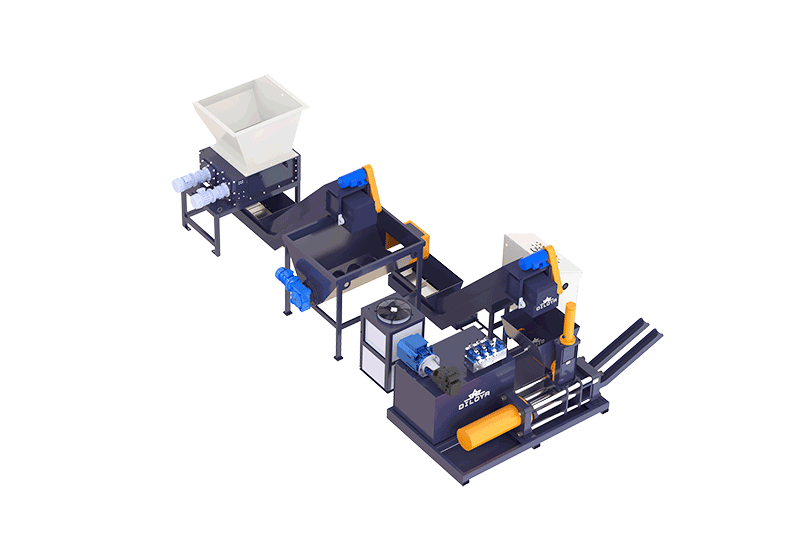
Automated four-shaft shredding and dual-outlet briquetting
The DILOYA Auto Metal Shavings Shred-Briquetting Line combines a four-shaft shredder, a large screw-equipped buffer hopper and a dual-outlet briquetting machine in one coordinated system. It is designed to shred suitable metal shavings and machining turnings, buffer the prepared chips and compress them into briquettes with reduced intermediate manual handling.
The line's key features are four-shaft size reduction with an optional sizing screen, a buffer hopper after shredding, dual-outlet briquette production and servo-controlled operation. Together, these provide a compact processing arrangement focused on automated feeding, high production potential and efficient use of energy.
Suitable feedstocks and preparation requirements
The line can be configured for different metal shavings and turnings, including suitable aluminium, iron or steel, copper and brass machining waste. Selection must consider the actual alloy, chip thickness, curl length, bundle size, loose bulk density and retained coolant or oil, rather than metal name alone.
Long or tangled turnings are first prepared by the four-shaft shredder so that the downstream hopper and feeding arrangement receive material suited to briquetting. Different metals and alloy grades should be processed separately according to the customer's recycling requirements. Tools, bar ends, large solid pieces and other foreign objects require removal or an agreed separation arrangement before processing.
Representative material samples help establish an appropriate shredder configuration, screen selection, feed arrangement and briquetting settings. The ability to handle one machining-chip sample does not automatically establish suitability for every type of metal scrap.
Process flow from metal shavings to finished briquettes
1> Load suitable shavings into the shredder. The loading method is selected for the customer's collection system and workshop conditions. Incoming bundles must remain within the agreed feed size and contamination limits.
2> Reduce the material with four-shaft shredding. The shredder cuts and breaks down the turnings into material suitable for the next stages. An optional sizing screen can be fitted when a more controlled discharge size is required.
3> Collect shredded material in the large buffer hopper. The hopper receives the shredder's output and provides a working reserve between size reduction and pressing.
4> Feed through the screw system. The screw arrangement transfers chips from the hopper to the briquetting machine in coordination with the pressing sequence.
5> Compress and discharge through the dual-outlet arrangement. The briquetting machine forms the prepared chips into briquettes and discharges them through its two-outlet design.
6> Collect the finished briquettes. Collection containers or onward handling equipment are selected to accommodate both outlets and the intended production rate.
Four-shaft shredding with an optional sizing screen
The four-shaft shredder is the preparation stage of this solution. Its purpose is to reduce metal shavings and turnings before they reach the hopper and press, helping the downstream system receive a more manageable feed.
Where the application requires it, the shredder can be equipped with a sizing screen to help control the discharged material size. The screen opening and cutting configuration should be selected together for the feedstock and the briquetting machine's requirements.
A screen helps control size distribution; it does not mean every discharged metal chip will have exactly the same dimensions. Chip geometry and material behavior still influence the result. Screen selection also affects the working conditions of the shredding stage, so the desired chip size and required throughput should be considered together and confirmed through material assessment.
A post-shredder screw hopper buffers material flow
The large screw-equipped hopper is positioned after shredding. It receives prepared material from the four-shaft shredder and holds a reserve for the briquetting machine. This gives the line an intermediate buffer instead of requiring the press to follow every short-term variation in shredder discharge directly.
The hopper and screw system link two different operations: the shredder prepares the incoming turnings, while the press repeatedly receives and compresses a charge. Buffering helps coordinate these stages and reduces the need for manual transfer of shredded chips between them.
Usable hopper volume should be selected for the shredded material's bulk density, expected shredder output and press consumption. The buffer cannot compensate indefinitely if the shredder's average output is below the press's demand; sustained production still requires the equipment capacities to be matched.
Dual-outlet briquetting for high production potential
The briquetting machine uses a dual-outlet design to support high-output briquette production within a compact arrangement. The two discharge points should be included in the collection layout so that finished material can be removed without obstructing either outlet.
With suitable feed material and a matched configuration, the machine can produce approximately 5–6 finished briquettes per minute. This figure is expressed as the total finished-briquette count for the machine, not as 5–6 briquettes per outlet or 5–6 complete dual-output cycles.
Actual production depends on the metal, shredded-chip size, bulk density, coolant condition, briquette dimensions and weight, and the selected pressing settings. Briquettes per minute describe piece output, not tonnes per hour. Mass throughput must be established using the actual briquette weight and sustained operating rate; it should not be inferred from the number of outlets alone.
Servo control for efficient, coordinated operation
The line adopts a servo control system as part of its high-output, energy-conscious configuration. The operating sequence is coordinated around the processing demand rather than treating shredding, feeding and pressing as unrelated manual tasks.
The energy-saving objective is to reduce unnecessary energy consumption during the configured operating cycle while maintaining the required production performance. The actual benefit depends on the selected drive and hydraulic arrangement, load profile, material and operating schedule. No fixed energy-saving percentage or electricity consumption per tonne should be assumed without a defined configuration and measured operating data.
When comparing proposals, evaluate energy consumption together with sustained output and briquette quality. Installed motor power alone does not establish the line's actual electricity use during production.
Compact layout and integrated automation
The shredder, buffer hopper, screw feed and dual-outlet press are arranged as a connected production cell. This reduces separate handling stations and supports a small-footprint installation compared with an arrangement that requires repeated intermediate storage and manual transfers.
The final layout must still provide loading access, shredder and screen maintenance clearance, hopper service access and collection space at both briquette outlets. Guarding, emergency stops and the required interlocks between equipment stages should be defined in the control and safety specification.
Operators continue to manage incoming material, monitor operation, collect finished briquettes and carry out inspection, cleaning and maintenance. Automation reduces repetitive feeding and transfer work; it does not eliminate supervision or the need for safe servicing procedures.
Configure the line around your material and production target
For a suitable proposal, provide metal and alloy details, representative shavings or turnings, bundle size, chip thickness, loose bulk density, coolant or oil condition and the required output. Also identify any desired shredded-chip size, preferred briquette diameter and weight, loading method, available floor area, electrical supply and collection arrangement.
DILOYA can then match the four-shaft shredder, optional sizing screen, buffer hopper, screw feed, servo-controlled press and dual-outlet discharge. Confirmed briquette rate, mass throughput, energy requirements and installed dimensions should be stated in the project-specific quotation and acceptance specification.