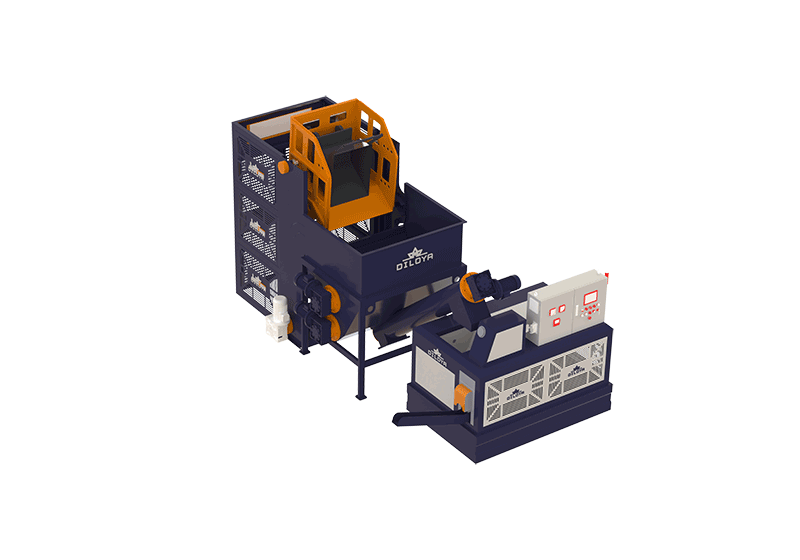
Integrated chip handling from collection trolley to finished briquette
The DILOYA Integrated Auto Metal Chips Briquetting Line combines a trolley lifting and tipping system, a large screw-equipped buffer hopper, screw conveying and hydraulic briquetting in one compact arrangement. It is designed for workshops that collect machining chips in wheeled trolleys and want to reduce the manual work involved in unloading, transferring and feeding loose material into a briquetting press.
The operating concept is straightforward: push the loaded chip trolley into the lifting and tipping station, discharge the chips into the large buffer hopper, convey them by screw to the briquetting machine, and collect the finished briquettes. Instead of treating loading, temporary storage and compression as separate jobs, the line links them into a coordinated material-handling process.
How the lifting, buffering and briquetting process works
> Collect chips at the machining area. Operators use suitable chip trolleys to collect material from machining centers or other production equipment. Different metals and alloy grades should be kept separate according to the workshop's recycling requirements.
> Position the trolley in the lifting and tipping station. The operator pushes a loaded trolley into the designated loading position. Trolley dimensions, loaded weight and the retaining arrangement must be matched to the lift before operation.
> Lift and tip into the large hopper. Once the trolley has been secured and the operating conditions are satisfied, the lifting and tipping system raises and turns the trolley to empty its contents into the buffer hopper. The trolley is then returned to the unloading position for removal and reuse.
> Buffer the batch of loose chips. The large hopper receives the trolley load and temporarily holds the material. This separates batch unloading from the more gradual feeding needs of the press, so an operator does not need to feed the briquetting chamber by hand throughout every cycle.
> Transfer chips through the screw feeding system. The hopper screw and screw conveyor move the material toward the briquetting machine. Feeding is coordinated with the press's demand, with the screw arrangement and control sequence selected for the actual chip characteristics.
> Compress and discharge. The hydraulic briquetting machine compresses the prepared feed into compact briquettes and discharges them for collection. Briquette dimensions, discharge arrangements and collection containers are selected to suit the material and the customer's handling requirements.
Three core functions in one compact system
1> Trolley lifting and tipping
The lifting and tipping station replaces repeated manual scooping or manual lifting of chip containers into an elevated hopper. It connects the customer's trolley-based collection routine to the processing line. The design must take account of trolley width, height, wheel arrangement, loading capacity, tipping clearance and the available approach space.
2> Large screw hopper for material buffering
The hopper is more than a receiving opening: it provides an intermediate storage point between trolley unloading and briquetting. A trolley can deliver a batch of chips while the screw feeding system transfers material onward at a rate suited to the press. Hopper working volume should be selected around the actual trolley load, loose bulk density and expected interval between deliveries, rather than nominal container volume alone.
3> Screw conveying and hydraulic briquetting
The screw conveyor links the buffer hopper to the press without an additional manual transfer stage. Its geometry, drive and feed arrangement must be matched to the material. The briquetting machine then completes the compression step. Bringing these functions together helps create an organized chip-handling station rather than a series of separately operated machines.
Compact footprint and a high level of integration
This solution is intended to bring lifting, tipping, buffering, conveying and briquetting into a closely arranged production cell. It is particularly relevant where a workshop needs automated chip handling but does not have room for a long material-transfer line or several separate storage stations.
A practical layout must still include the trolley approach route, the lift's operating envelope, access for cleaning and maintenance, and space for the finished-briquette container. DILOYA can match the arrangement to the customer's available floor area and ceiling height. A compact equipment footprint should not come at the expense of safe access or routine service work.
Less manual handling, more coordinated operation
> Fewer repeated transfer tasks: the trolley is emptied by the lifting and tipping system, and screws carry the material onward instead of requiring repeated hand feeding.
> Buffered feeding: the hopper holds material between trolley deliveries, reducing the need for an operator to remain beside the press for each feed cycle.
> Integrated automation: lifting, material availability, screw feeding and pressing can be coordinated through the agreed control sequence rather than operated as unrelated steps.
> A clearer operator role: personnel focus on collecting and positioning trolleys, monitoring the equipment, removing finished briquettes and carrying out inspections.
The degree of labor saving depends on the existing collection method, trolley delivery frequency, material behavior and shift pattern. This is an automated handling and briquetting solution, not a claim that collection, supervision, cleaning or maintenance can be eliminated.
Match the line to the actual metal chips
The feed system and briquetting press must be selected together for the customer's metal type, chip size, shape, moisture or coolant content and required output. Aluminum, steel or iron, copper and other machining materials require individual assessment; different metals should not be mixed simply because they share the same handling equipment.
Long, tangled turnings or material that bridges in a hopper may require upstream size reduction or another preparation step. The standard process described here is lifting and tipping, hopper buffering, screw conveying and briquetting; a shredder should only be added when the actual feed material requires it. Trials with representative chips help establish a suitable configuration.
Controls, safety and optional equipment
The final specification should define trolley retention, guarded lifting and tipping areas, emergency stops and the interlocks needed between the lift, hopper screws and press. Material-level monitoring and feed-demand control can be specified to coordinate loading and pressing. Access for clearing blockages must be considered during layout design, and maintenance must follow the supplied isolation procedures.
Depending on the material and project requirements, the line can be configured with appropriate fluid collection, additional chip preparation, briquette discharge equipment or collection containers. These features should be confirmed in the quotation rather than assumed to be included in every system.
Information needed to configure your line
To prepare a suitable proposal, provide the metal and alloy, representative chip photos or samples, average and peak chip generation, trolley dimensions and maximum loaded weight, available floor space and clear height, working hours, local electrical supply and preferred briquette collection method. DILOYA can then coordinate the lifting station, hopper capacity, screw feeding and briquetting press around the workshop's actual operation.