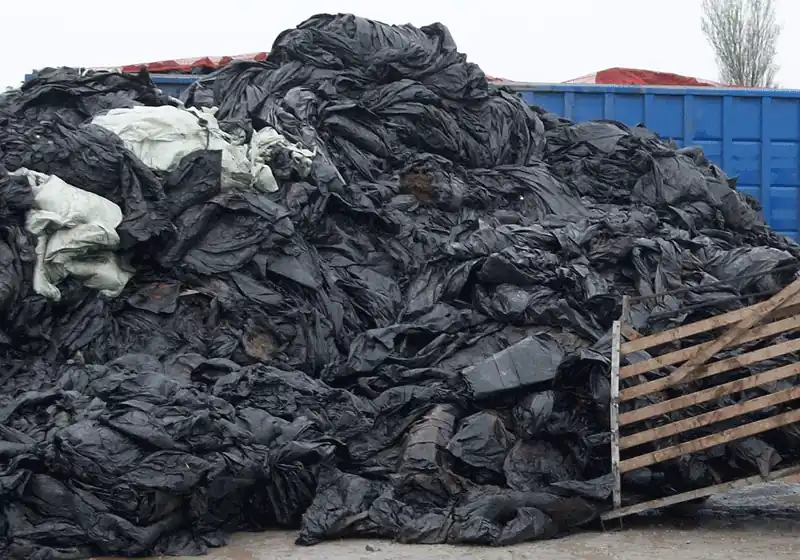
Where does waste agricultural film come from?
Typical sources include used mulch film removed from fields, greenhouse and tunnel covers, silage sheets and bale wrap. Collectors may receive loose film, tangled bundles or compressed loads. Keep different polymers and film streams separate wherever practical; their contamination and recycling requirements can differ.
Why is agricultural film difficult to process?
Thin, flexible film occupies a large volume and can bridge across a hopper, wrap around rotating parts or feed unevenly. Soil, sand, stones, crop residues, moisture and other foreign material increase wear and cleaning demand. Weathering and mixed polymers can also affect the quality and intended use of the recycled material.
Pre-cutting with a Horizontal Grid Shear
For bulky or tightly tangled loads that require pre-cutting, a Horizontal Grid Shear reduces the incoming film into more manageable sections before the shredder. Its role is feed preparation, rather than washing or polymer separation. Remove stones, metal and other unsuitable hard objects first, and confirm cutting behaviour with representative material.
From shredding to feedstock for pelletizing
A typical preparation route is sorting and removal of foreign material, grid-shear pre-cutting, shredding and a suitable film crusher or granulator for further size reduction. Washing, separation, dewatering and drying must be included as required by the contamination and receiving process. Their position in the line is selected for the actual feedstock; dry shredding alone does not produce clean pelletizing feed.
The prepared film can then enter a compatible extrusion and pelletizing line, with melt filtration and other conditioning specified by the downstream processor. Agree limits for moisture, contamination, polymer composition and particle size before selecting equipment. Recycled pellet quality depends on the whole process and cannot be guaranteed by the shear or shredder alone.
Plan the line around your incoming film
Send DILOYA photographs of the incoming film, its source and polymer type where known, the way it is delivered, contamination and moisture conditions, required throughput, available space and local power supply. Representative trials should establish feeding, cutting and downstream handling requirements before a machine configuration is confirmed.