A German customer uses an integrated shredding and briquetting line to process aluminium turnings at a reported rate of 30–50 kg per hour. The line connects a single-shaft shredder, a conveyor and a BPM small briquetting press under PLC automatic control. Long, curled turnings are shredded first, conveyed to the press and compacted into manageable briquettes for collection and recycling.
The project is designed to reduce repeated manual transfer and the space occupied by loose aluminium swarf. Its practical objectives are lower labour requirements, more efficient storage and transport, and cleaner, organized material handling. These benefits are described through the process arrangement rather than unsupported savings percentages or environmental-performance claims.
Germany Aluminium Turnings Project At A Glance
Customer location: Germany.
Raw material: aluminium turnings and curled machining swarf.
Reported processing output: 30–50 kg/hour.
Size-reduction stage: single-shaft shredder.
Material transfer: conveyor between the shredder and press.
Compaction stage: BPM small briquetting press.
Control arrangement: PLC automation for the complete line.
Project focus: coordinated material preparation, transfer and briquetting, with reduced manual handling and more compact storage.
Why Aluminium Turnings Need A Coordinated Process
Aluminium turnings are machining residues that can contain long curls, spirals and tangled strands. Their loose form leaves gaps in collection bins and can make consistent feeding difficult. For a small material stream, a large stand-alone machine is not automatically the most useful solution: preparation, transfer and pressing need to work together at the customer's required rate.
This German application therefore combines shredding and briquetting as one production-line design. The first stage prepares the turnings for the downstream feed arrangement; the conveyor then transfers that prepared material to the press. The Aluminium Turnings application page provides additional context for distinguishing this feed from aluminium profiles, sheet offcuts or used beverage cans.
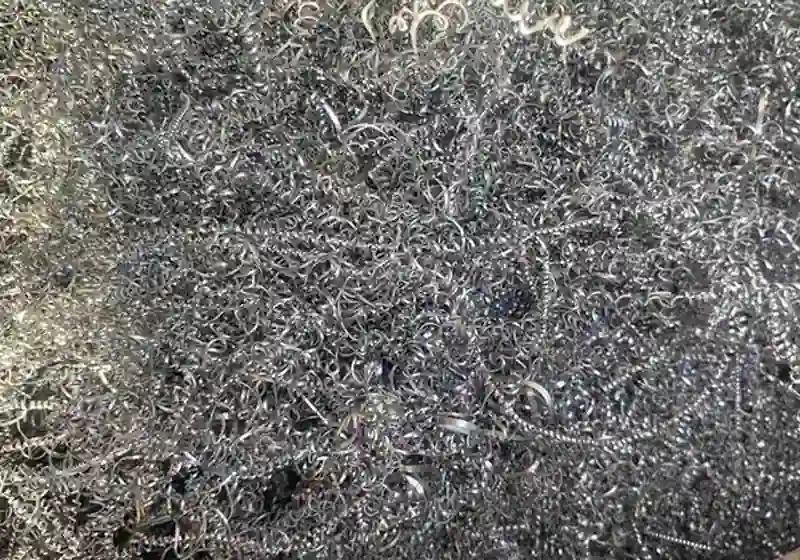
Incoming material: curled aluminium turnings before the shredding and briquetting process.
Step 1: Single-Shaft Shredding Before Briquetting
The aluminium turnings enter a single-shaft shredder before pressing. In this project, size reduction addresses the long and tangled form of the incoming swarf and prepares it for the conveyor and briquetting stage. This is a material-preparation operation, not the final densification step.
The required shredder setup should be checked against representative turnings, including strand length, alloy, contamination and the actual incoming condition. A shredder should not be treated as a substitute for sorting out unsuitable material. No cutter geometry, screen size or finished particle-size specification has been supplied for this installation, so those details are not added as project facts.
Step 2: Conveyor Transfer To The BPM Press
After shredding, a conveyor transports the prepared aluminium material to the BPM small briquetting press. Connecting the stages reduces the need to carry each batch manually between separate machines. It also establishes a defined transfer route within the line, making material flow easier to organize around the pressing stage.
The conveyor is part of the overall process rather than an independent guarantee of capacity. Its feed rate and receiving arrangement need to suit the actual shredded material and the press's operating sequence. Collection before the shredder and removal of finished briquettes still require a practical handling plan.
Step 3: Briquetting In The BPM Small Press
The BPM small briquetting press compacts the prepared aluminium turnings into briquettes. This changes the material from loose, irregular swarf into discrete packages that are easier to collect, weigh and arrange for subsequent handling. The supplied photographs show cylindrical finished pieces, without establishing an unreported diameter, mass or density.
The related Small Briquetting Press product page explains the compact metal-chip pressing application. Unlike melting, the pressing stage forms a package through mechanical compaction. Suitability for a particular recycler still depends on material quality and the agreed receiving specification.
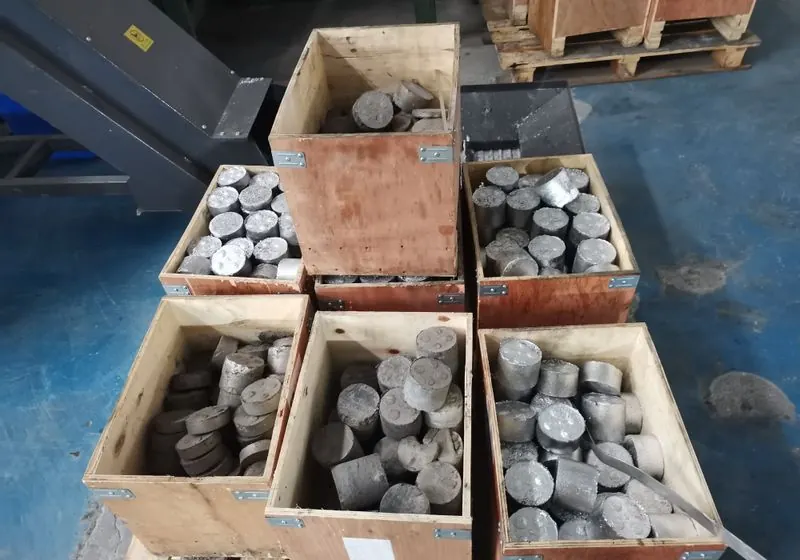
Finished material: aluminium briquettes collected in boxes for weighing and subsequent handling.
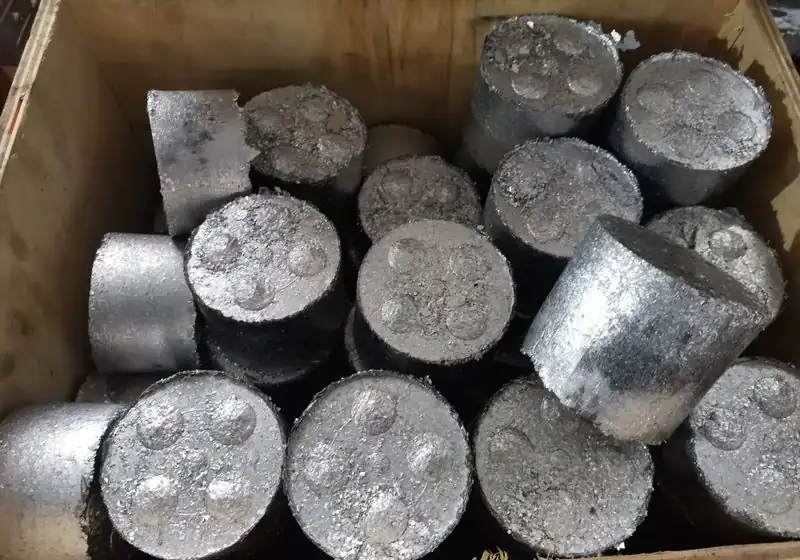
Briquette detail: compacted aluminium turnings formed into cylindrical pieces.
PLC Automation Across The Complete Line
The complete line uses PLC automatic control to coordinate its configured operations. Integrating the shredder, conveyor and press under a common control arrangement supports a more consistent sequence than treating material transfer as a series of unrelated manual tasks.
Automation does not mean the installation can operate without supervision or that operators may enter moving-equipment areas. Permitted modes, protective interlocks, stopping and restarting must follow the supplied machine documentation. The customer has specified PLC control, but has not identified remote control, internet monitoring or an unattended-operation capability; these are not claimed for this project.
Reported Capacity Of 30–50 kg Per Hour
The supplied production range is 30–50 kg/hour for the aluminium-turnings application. It is a mass-throughput figure, not a count of briquettes or an individual briquette weight. The line should be assessed as a complete system, including preparation, transfer, pressing and the handling needed to sustain the intended operation.
Actual output depends on the incoming swarf and the coordinated performance of all stages. For a comparable project, agree the material sample, measurement period and handling steps included in the capacity assessment. A press-only cycle or a nominal shredder rating should not be substituted for demonstrated whole-line throughput.
Labour, Transport And Storage Benefits
Labour: conveyor transfer and PLC-coordinated sequencing reduce repeated manual movement between the shredder and press. Operators can focus on supplying suitable material, supervising the process and managing the output. No exact staffing reduction has been supplied for this customer.
Storage: briquetting reduces the loose form of the material and produces defined pieces that can be collected in suitable containers. The required storage area depends on the actual output volume, container arrangement, access and handling plan; it should not be estimated from photographs alone.
Transport: compact packages can make better use of available container space than loose, spring-like turnings. The actual cost effect depends on package properties, payload limits and the customer's shipping arrangements. No freight-saving percentage or financial payback period is asserted.
Environmental And Recycling Considerations
The line supports more organized recycling through controlled transfer and compacted output. Keeping compatible aluminium grades separated and limiting contamination remain important throughout collection and processing. Environmental efficiency also depends on the site's handling of any fluids, fines and residues associated with the incoming swarf.
No dedicated coolant-recovery system, dust-extraction package, emissions measurement or energy-consumption result has been specified for this installation. Such arrangements should be assessed against the actual material and site requirements rather than implied by the word “automatic”. The project is presented as an integrated handling and compaction solution, not as a claim of zero emissions or zero waste.
Information Needed For A Similar Project
Provide photographs or samples of the aluminium turnings, typical strand length, alloy information, fluid condition, contamination, daily quantity and intended working hours. Include available power, space for the complete line, access for maintenance and the recycler's briquette requirements. These details help match shredding, conveying and pressing around one practical production target.
Customer Case FAQ
What Is The Process Sequence?
Aluminium turnings pass through a single-shaft shredder, move by conveyor to a BPM small briquetting press and are compacted into briquettes. The complete line uses PLC automatic control.
Does 30–50 kg/Hour Describe The Briquette Weight?
No. It is the reported hourly material-processing range for this application. Individual briquette weight and dimensions have not been supplied.
How Does The Line Reduce Handling Costs?
Connected conveying reduces manual transfer between stages, while briquetting converts loose turnings into more manageable packages for storage and transport. Actual savings depend on the customer's material flow and operating arrangements; no measured percentage has been provided.
