A customer in Greece required an aluminium chip briquetting solution for a target capacity of 600–800 kg per hour. Based on this requirement, a Double Outlet Briquetting Press was recommended. The selected concept combines two briquette-discharge outlets with PLC fully automatic control, with a stated production rate of 5–6 briquettes per minute.
The application concerns aluminium machining chips, not aluminium profiles or empty beverage cans. The objective is to turn suitable prepared chips into defined briquettes while coordinating feeding, pressing and finished-product collection. The hourly figure is the customer's capacity requirement; it should not be presented as an independently verified acceptance-test result.
Greece Aluminium Chip Briquetting Project At A Glance
Customer location: Greece.
Material: aluminium chips from machining operations.
Customer capacity requirement: 600–800 kg/hour.
Recommended equipment: Double Outlet Briquetting Press.
Discharge design: two outlets for finished briquettes.
Stated production rate: 5–6 briquettes/minute, described here as the machine total rather than a per-outlet rate.
Control system: PLC fully automatic control.
Process focus: coordinated feeding, hydraulic compaction, discharge and collection.
Matching The Press To The Aluminium Chip Stream
Aluminium chips vary with the machining process. Particle shape, alloy, retained fluid and contamination influence how material fills the press and how the finished briquette holds together. The customer's required mass throughput therefore needs to be considered alongside a representative chip sample and the intended collection workflow.
Loose chips leave gaps in collection containers and can be awkward to move as an unstructured mass. Briquetting consolidates suitable chips into discrete pieces that can be collected, weighed and organized for recycling. The receiving recycler's quality requirements still apply: pressing does not remove the need for material sorting and contamination control.
Why Recommend A Double Outlet Briquetting Press?
The distinguishing feature of the Double Outlet Briquetting Press is its two finished-briquette outlets. This gives the handling layout two defined discharge positions and allows the collection arrangement to be planned around the press rather than treated as an afterthought.
For the Greek customer's 600–800 kg/hour requirement, the recommendation considers both pressing and the removal of finished pieces. Keeping the outlet areas clear and providing suitable receiving containers are important parts of useful production. Two outlets do not automatically prove twice the output of a single-outlet machine; the actual result depends on the selected configuration, feed and complete cycle.
The supplied photographs illustrate dual-outlet equipment and production-line handling. They support the explanation of the discharge concept without implying that every pictured auxiliary unit is included in the customer's final supply scope.
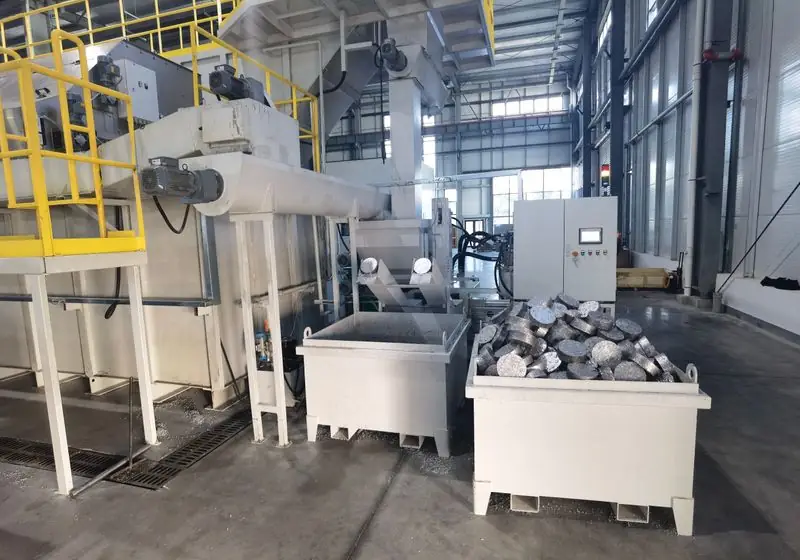
Supporting line view: two briquette-discharge positions with collection containers.
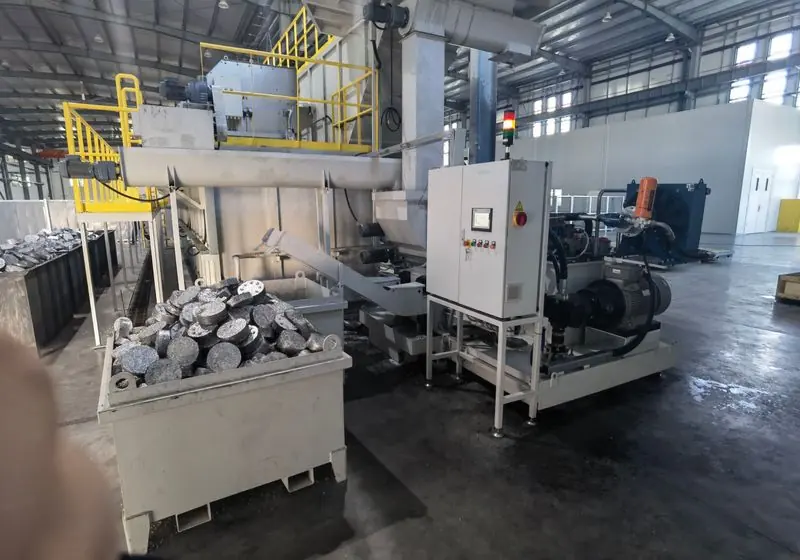
Supporting process view: press controls, material transfer and finished-briquette handling.
Machine Operating Flow: From Chips To Collected Briquettes
Process overview: material preparation → controlled feeding → hydraulic compression and forming → discharge through the configured outlets → collection → return to the next automatic cycle. The following describes the production concept, not a substitute for the supplied operating instructions.
1. Prepare And Check The Aluminium Chips
Keep compatible grades separated and assess the incoming chip condition against the agreed specification. Identify unsuitable inclusions and any long tangled material that could interfere with feeding. Additional shredding, drainage or other preparation should be specified only where the actual material requires it; a separate shredder has not been confirmed for this Greek project.
2. Supply The Press Through Its Feeding Arrangement
Prepared chips are supplied to the press's receiving and feeding arrangement. Consistent material delivery supports repeatable filling rather than allowing irregular charges or interruptions to dictate the production rhythm. The particular conveyor, hopper capacity and dosing hardware must be confirmed for the supplied machine rather than inferred from a supporting photograph.
3. Compress And Form The Briquette
The hydraulic system applies the configured compression sequence to the material charge and forms a briquette. Chip condition, filling and the selected machine settings affect the resulting piece. No pressing-force value, pressure setting, dwell time, density or briquette size has been supplied for this case, so none is invented.
4. Discharge Through The Two-Outlet Arrangement
Finished pieces leave through the machine's configured dual-outlet arrangement and move to the receiving positions. Outlet timing and whether discharge is simultaneous or sequential depend on the supplied machine design and PLC program. This case does not assume a particular alternation pattern or claim that each outlet independently produces 5–6 pieces per minute.
5. Collect The Output And Continue The Automatic Cycle
Finished briquettes are collected under the site's approved handling arrangement, while the machine returns to its next configured cycle when the required conditions are satisfied. Collection capacity and access should suit the intended production flow. PLC automation coordinates the specified sequence, but supervision, guarding and maintenance remain necessary.
Understanding Capacity And Briquette Count
The project records two distinct figures: a customer requirement of 600–800 kg/hour and a stated machine production rate of 5–6 briquettes/minute. The first is a mass-throughput target; the second counts finished pieces over time. They should be documented separately during equipment selection and testing.
These numbers alone do not establish an individual briquette weight, exact cycle time or guaranteed continuous hourly output. To verify the recommended configuration, use representative aluminium chips, measure the collected mass over an agreed test period and record the completed-briquette count for the same conditions. Include relevant feeding and collection interruptions in the agreed assessment method.
Finished Aluminium Chip Briquettes
The supporting finished-product photographs show cylindrical aluminium briquettes. They illustrate the change from loose chips to defined pieces without assigning an unreported weight, diameter or density to any photographed sample. The buyer's acceptance criteria should define the required material quality and package properties.
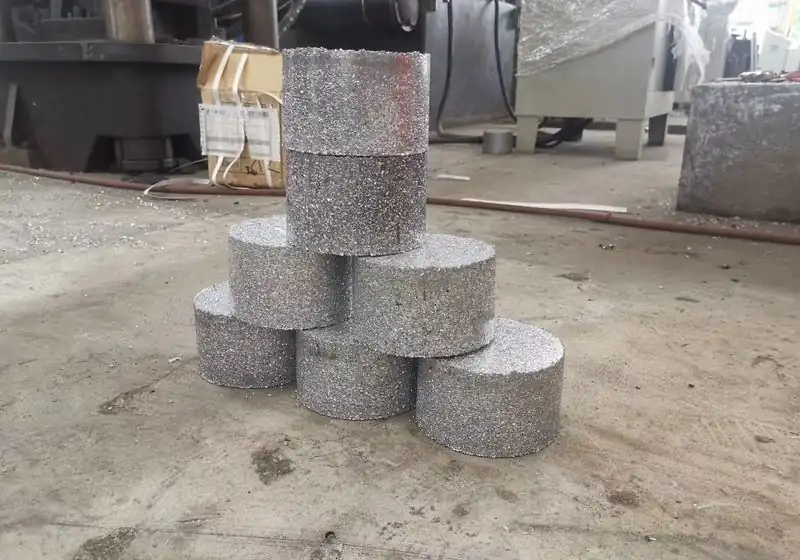
Finished-product example: cylindrical briquettes formed from compacted aluminium chips.
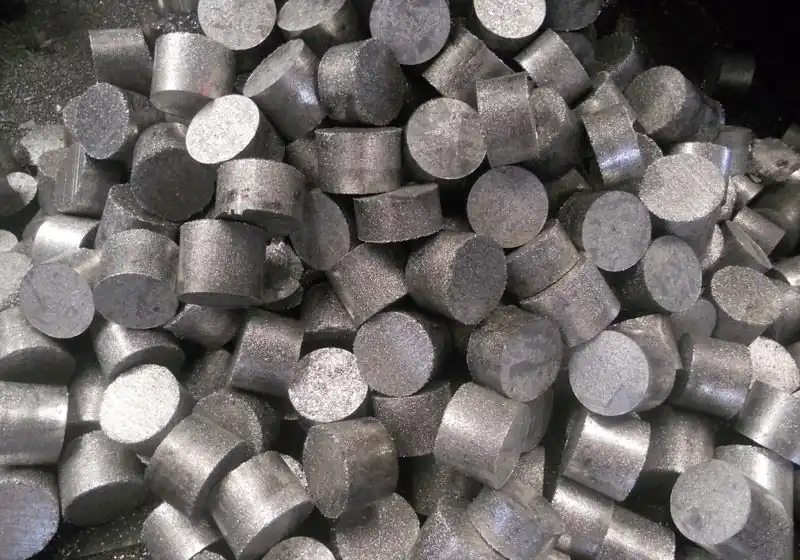
Finished-product detail: collected aluminium briquettes showing their cylindrical form.
PLC Automation And Practical Handling Benefits
PLC fully automatic control provides a consistent framework for the specified feeding, compression and discharge operations. With a suitable collection plan, the dual-outlet arrangement can reduce repeated intervention at the discharge positions and make finished-product handling easier to organize.
Compact briquettes can simplify weighing, inventory and transport preparation compared with loose chips. Actual labour, storage and freight effects depend on the site's workflow and receiving requirements. No savings percentage, staffing reduction or payback period has been supplied. Likewise, remote control, unattended operation and a dedicated coolant-recovery package are not claimed for this project.
Comparing This Requirement With A Smaller Chip-Recovery Line
The Aluminium Turnings Shredding And Briquetting Line In Germany case describes a different application: curled turnings prepared by a single-shaft shredder and conveyed to a BPM small press at a reported 30–50 kg/hour. It illustrates why material form and production requirements should guide equipment selection rather than treating all aluminium residues as the same feed.
For a similar Greek installation, provide chip samples, alloy information, fluid condition, daily quantity, operating hours, available power and the receiving recycler's briquette requirements. A layout showing feeding, both outlet areas and container access helps match the machine to the complete working process.
Customer Case FAQ
Is 600–800 kg/Hour A Verified Production Result?
It is the customer's stated capacity requirement used for recommending the Double Outlet Briquetting Press. A representative acceptance test is needed to confirm the selected machine's achieved throughput under agreed conditions.
Does Each Outlet Produce 5–6 Briquettes Per Minute?
The supplied figure is described as 5–6 briquettes per minute for the machine in total. A separate per-outlet rate and the outlet timing sequence have not been provided.
What Does The Automatic Operating Sequence Include?
At process level, it includes prepared-chip feeding, hydraulic compression and forming, configured dual-outlet discharge, collection and repetition of the cycle under PLC control. The detailed sequence and protective conditions must follow the supplied machine documentation.
