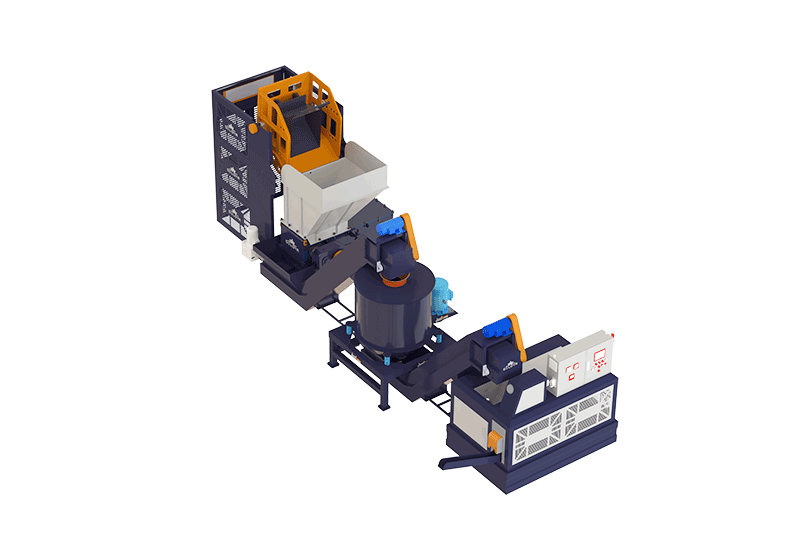
Integrated shredding, centrifugal de-oiling and briquetting
The DILOYA Metal Turning Shred-Centrifuging Briquette Line processes tangled machining turnings through a coordinated sequence of trolley lifting and tipping, single-shaft shredding, centrifugal fluid separation and hydraulic briquetting. It is intended for workshops handling bundled or clumped metal turnings that need both size reduction and de-oiling before compression.
Typical feedstocks include suitable iron or steel turnings, aluminium turnings and copper turnings. The line brings the handling and preparation stages together so that a loaded chip trolley can supply a connected processing system instead of requiring operators to transfer material manually between separate machines.
Suitable for tangled and bundled metal turnings
> Iron and steel turnings: curled or tangled ferrous machining waste, assessed for chip thickness, toughness, bundle size and foreign objects.
> Aluminium turnings: loose or clumped aluminium machining chips, with shredding, centrifuging and pressing selected for the actual alloy and chip condition.
> Copper turnings: bundled copper machining waste requiring suitable size reduction, fluid separation and compression.
> Other machining turnings: additional metals and chip forms can be evaluated using representative material samples before configuration.
The defining application is not simply a particular metal: it is the combination of tangled turnings, retained machining fluid and a requirement for subsequent briquetting. Different metals and alloy grades should be collected and processed separately according to the customer's recycling requirements.
Bar ends, tools, large solid pieces and other contaminants are not the same as machining turnings. Their removal or separation requirements must be considered before material enters the shredder and centrifuge.
Process flow from a loaded trolley to finished briquettes
1> Collect turnings in a suitable trolley. The workshop collects machining turnings in a wheeled container matched to the lifting station. Trolley dimensions, loaded weight and the material condition are confirmed during configuration.
2> Lift and tip into the single-shaft shredder. The operator positions the trolley in the loading station. After the trolley is retained and the operating conditions are satisfied, the lift raises and tips it to discharge the bundled turnings into the shredder's receiving area.
3> Shred the tangled material. The single-shaft shredder reduces the turnings into shorter pieces suitable for the downstream process. Its configuration must be matched to the metal, chip geometry and incoming bundle size.
4> Transfer to the centrifuge. Shredded chips move through the configured transfer system to the centrifugal de-oiling unit. Material delivery must be coordinated with the centrifuge's processing capacity.
5> Separate retained fluid by centrifuging. The centrifuge spins the prepared chips to separate retained cutting oil or suitable machining fluid. Separated liquid is directed to the specified collection arrangement, while the treated chips move onward.
6> Feed and briquette the treated chips. The de-oiled material is supplied to the hydraulic briquetting machine, which compresses it into briquettes for collection and onward handling.
Single-shaft shredding prepares the turnings for downstream processing
Long, curled turnings can arrive as intertwined bundles rather than a readily manageable feed. The shredding stage addresses this condition before centrifugal separation and briquetting. Breaking the bundles into shorter chips helps prepare the material for the subsequent handling stages.
The shredder must be selected for the actual feedstock rather than metal name alone. Iron or steel, aluminium and copper turnings can differ in toughness, chip thickness and bundle structure. Feed trials help establish a suitable shredding arrangement and confirm that the discharged material meets downstream requirements.
The line should not be specified on the assumption that every solid object can pass through the shredder. Acceptable feed size, contamination limits and any required upstream sorting should be defined in the project specification.
Centrifugal de-oiling before briquetting
The centrifuging stage provides a dedicated fluid-separation step between shredding and compression. It treats the prepared chips before they enter the briquetting machine, rather than relying only on the final pressing stage to manage retained liquid.
With suitable material, equipment selection and operating conditions, residual oil content after centrifuging can reach approximately 3%. This figure refers to the treated chips leaving the centrifuge; it should not be presented as a universal result for all materials or as a guaranteed oil content of the finished briquettes.
Achievable residual oil content depends on the initial oil loading, chip size and shape, metal type, oil properties, feed rate and centrifuge operating conditions. The sampling location, measurement method and percentage basis should be agreed when confirming performance. Representative material testing is needed where the residual oil figure forms part of the customer's acceptance requirements.
Centrifuging mechanically separates retained liquid; it is not a washing process or a promise of completely oil-free material. When the feed contains water-based coolant rather than neat cutting oil, the relevant residual-fluid requirement should be defined separately instead of assuming that oil and total liquid content are interchangeable.
Fluid collection and briquette discharge are separate handling streams
The line produces a treated metal stream and a separated fluid stream. Collection arrangements should be planned for both. Recovered liquid should be assessed and, where necessary, filtered or otherwise treated before any reuse; direct return to a machining system is not assumed as part of every configuration.
After centrifuging, the briquetting press forms the chips into compact units. Press selection, briquette dimensions, target weight and discharge arrangements are matched to the material and the customer's recycling workflow. Any additional fluid released during pressing should be handled through the specified collection arrangement.
High automation across the complete line
The lifting and tipping station, shredder, centrifuge, transfer equipment and briquetting press can operate under a coordinated control sequence. The objective is to reduce repeated manual loading and intermediate transfers while keeping the connected stages supplied at a compatible rate.
> Automated trolley unloading: the lifting and tipping system transfers a prepared trolley load to the shredder.
> Connected processing stages: shredding, centrifugal de-oiling and briquetting follow the defined process sequence.
> Coordinated material delivery: the feed arrangement is selected to match the downstream equipment rather than overload an individual stage.
> Defined operator responsibilities: personnel collect and position trolleys, supervise operation, remove collected material and fluids, and perform inspections and maintenance.
The final control specification should identify the necessary machine interlocks, guards, emergency stops and access arrangements. High automation reduces repetitive handling but does not eliminate the need for trained supervision or safe isolation during servicing.
Configure capacity around the entire process
Line output depends on more than the briquetting press. The lifting cycle, shredder performance, chip transfer rate, centrifuge capacity and desired residual-fluid condition must be matched to one another. Actual throughput will vary with the metal, chip form, initial fluid content and required briquette characteristics.
To prepare a project-specific proposal, provide representative turnings, metal and alloy details, trolley dimensions and maximum loaded weight, average and peak material generation, machining-fluid type and initial content, target residual oil or fluid level, required output and preferred briquette size. Available floor space, ceiling height, electrical supply, service access and liquid collection requirements should also be included.
DILOYA can then coordinate the trolley lift, single-shaft shredder, centrifuge and briquetting machine as one processing line. Confirmed throughput, residual oil performance, equipment dimensions and any optional separation or fluid-treatment equipment should be stated in the final quotation and acceptance specification.