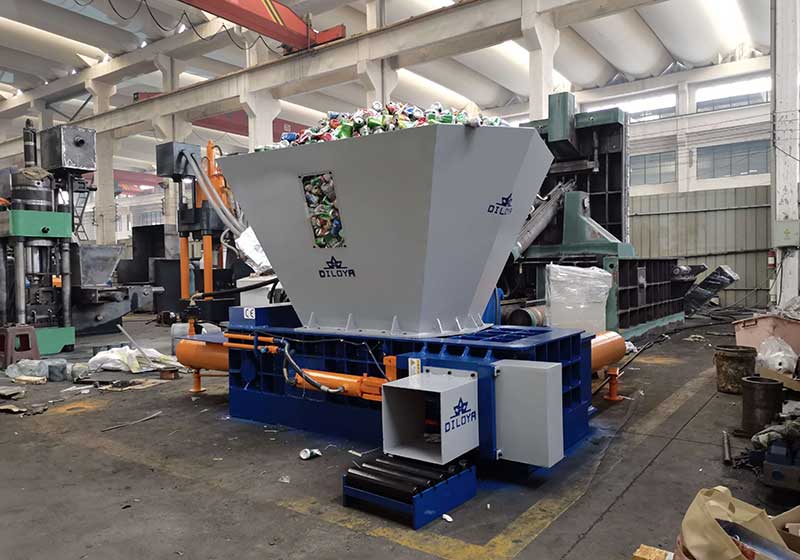
Hydraulic pressure, pressing force and bale density describe different things. Hydraulic pressure acts inside the oil circuit. Cylinder force is the mechanical force produced by the hydraulic actuator. Bale density is the mass of the finished bale divided by its external volume. Comparing these terms as though they were interchangeable can lead to poor equipment selection and unrealistic acceptance criteria. Start with your actual cans and the buyer’s bale specification, then assess the machine and operating sequence needed to meet it.
Define The Three Measurements Before Comparing Machines
Hydraulic Circuit Pressure
Hydraulic pressure is normally stated in bar or MPa and must be associated with a particular circuit, measurement point and operating condition. A maximum pressure rating, a relief setting and a measured pressure during pressing are not necessarily the same value. Ask the supplier what its published figure represents. For unit comparison, 1 MPa equals 10 bar. This conversion does not tell you the pressing force unless the cylinder dimensions and active direction are also known.
Cylinder Force And Pressing Force
For an idealized single-cylinder extension calculation, force equals pressure multiplied by effective piston area: F = P × A. Use pressure in pascals and area in square metres to obtain force in newtons. A rod-side calculation uses the annular area rather than the full piston area. Real machine performance also involves back pressure, mechanical losses and the compression arrangement. Parker’s Cylinder Sizing Tools distinguish operating pressure, cap-end and rod-end areas, and push/pull force; these distinctions explain why pressure alone is not a complete machine comparison.
Do not add the rated forces of several cylinders unless the supplier confirms how they act on the material during the relevant stage. A pre-compression cylinder, a main pressing ram and an ejection cylinder may perform different functions. Similarly, the word “ton” may refer to force in equipment advertising or to material mass in production reporting. Request clearly stated units, the relevant ram and the operating condition rather than relying on an ambiguous tonnage label.
Finished Bale Density
Bale density is a result measured on the discharged package. It depends on the mass inside that package and its actual external dimensions. It is not the density of solid aluminium, the loose bulk density of incoming cans, or the bulk density of several bales arranged inside a container. If these measurements are not separated, a specification can look precise while actually describing different quantities. Define the measurement method as well as the target.
A Calculation Example: Why Oil Pressure Is Not Bale Density
Illustrative calculation only—not a DILOYA model specification: suppose a cylinder operates at 20 MPa with an effective piston area of 0.020 m². The ideal force is 20,000,000 × 0.020 = 400,000 N, or 400 kN. If that force acts over a hypothetical 0.40 m² pressing face, its nominal average face stress is 1 MPa. These calculations describe force and average stress, not a prediction of bale density. Actual stress within a bed of cans is not necessarily uniform.
A second machine operating at the same oil pressure can produce a different force because its piston area is different. Changing the pressing face area changes the nominal average stress again. The Hydraulic Can Baler selection should therefore consider cylinder arrangement, chamber dimensions, material preparation and the complete cycle—not only a pressure number in a brochure.
How To Calculate Aluminium Can Bale Density
For an approximately rectangular bale, use density in kg/m³ = bale mass in kg ÷ (length × width × height in metres). Weigh the bale using an appropriate checked scale. Measure its external dimensions after discharge using the agreed method and settling time. Keep the treatment of straps, pallets and other packaging consistent. If a bale has a noticeably irregular shape, agree how its volume will be assessed rather than forcing a convenient box measurement into the calculation.
Example only: a hypothetical 100 kg bale measuring 0.80 × 0.50 × 0.40 m occupies 0.160 m³. Its calculated apparent bale density is 100 ÷ 0.160 = 625 kg/m³. This number is an arithmetic demonstration, not a recommended density, guaranteed result or claim about a photographed bale. The acceptable target must be agreed with the receiving recycler and validated on representative material.
The FAQ What Determines Aluminium Can Bale Size And Weight? explains why package dimensions and mass should be considered together. A heavy bale is not automatically denser if its dimensions are also larger.
Why The Same Machine Can Produce Different Bales
Incoming Can Condition And Composition
Loose intact cans, previously flattened cans and irregular production rejects pack differently in the receiving space. Material composition and contamination also change the result. Residual liquid can add weight without representing additional recovered aluminium, so a higher measured mass does not automatically mean a better-quality bale. Document preparation and follow the receiving buyer’s requirements. Keep aluminium and steel streams separate where grade control requires it, even when a machine can physically process both materials.
Filling Consistency And Compression Sequence
Uneven loading, bridging above the chamber or inconsistent batch sizes can produce variable package dimensions and cycle times. A hopper and conveyor should deliver a controlled feed rather than simply the greatest possible volume. The suitability of a Hopper-Fed Can Baler depends on the material’s behaviour and the production pattern. Observe how the chamber fills, not only how quickly the conveyor moves.
Discharge, Retention And Spring-Back
The dimensions inside the chamber may differ from those of the package after release. Measure the discharged bale and record any expansion over the agreed interval. Where tying or another retention method is part of the design, evaluate it as part of the system rather than as an optional detail. The package must remain manageable through the intended lifting, stacking and loading operations. A dense-looking bale that breaks apart during normal handling does not meet the same practical objective.
Balance Density With Throughput, Energy And Acceptance
The goal is an accepted, stable package at a useful production rate—not the highest isolated density reading. Ask how the proposed sequence affects complete-cycle output and electricity consumption on your material. More compression time does not automatically improve the overall process, and the optimum operating point cannot be selected from a general article. An Automatic UBC Baler should be evaluated with its feed, discharge and operator tasks included in the test.
For transport planning, consider both vehicle volume and permissible payload, as well as bale dimensions and the loading arrangement. Increased density may help a volume-limited shipment, but it cannot remove a payload limit or resolve an incompatible bale size. The purchasing implications are discussed in Aluminium Can Baling Machine Price: Cost Factors And Buying Guide.
Set Up A Repeatable Bale Acceptance Test
Define the feed: material grade, can condition, preparation and permitted contamination.
Record the machine configuration: model, relevant approved settings, feed arrangement and compression/discharge sequence.
Agree the measurement method: scale, dimensions, treatment of packaging and time after discharge.
Measure more than one bale: record each result and variation rather than reporting only the best package.
Measure sustained output: include the agreed handling steps and interruptions over the same trial.
Check package acceptance: confirm buyer requirements and the site’s safe handling arrangement.
Keep the test sheet with the quotation and commissioning record. If performance is conditional on a specified material, preparation or operating pattern, write that condition beside the result. The FAQ What Affects Aluminium Can Bale Density? is a useful companion when preparing the trial questions.
What To Do If Density Falls During Production
First compare the new feed and operating records with the approved baseline. Has the can composition, batch size, liquid content, bale length or handling method changed? Check for alarms and visible abnormalities from a safe position. A change in density is not proof of a pressure fault. Where the machine also shows slower cycles, abnormal temperature, leakage or inconsistent movement, stop as required by the operating procedure and arrange qualified inspection.
Do not raise hydraulic pressure, adjust relief valves or defeat a protective function to compensate for an unexplained change. Use the model-specific limits and authorized service process. For a structured approach, read Hydraulic Can Baler Maintenance: Inspection And Preventive Care.
Questions To Ask Before Choosing A Density Target
What Density Does My Buyer Actually Require?
Ask for the current receiving specification, including material grade, maximum contamination, package dimensions, weight and handling integrity. There is no single target in this article that replaces a buyer’s acceptance conditions. Agree a measurable requirement and test it with your feed.
Can I Predict Density From Hydraulic Pressure Alone?
No. Pressure and cylinder area help explain ideal force, but they do not describe all the material and machine variables that determine the discharged bale. A representative material trial is more informative than a comparison of pressure figures alone.
What Information Should I Send To DILOYA?
Provide can photographs, loose feed condition, daily mass, intended processing hours, buyer’s bale requirements and current handling method. If replacing an existing machine, include measured bale mass and dimensions with the measurement method. This gives the supplier a practical target for configuration and acceptance rather than an unsupported request for “maximum density.”